
📑 Quick Navigation: Table of Contents
1. Quick Answer: $150k a Year Is How Much an Hour?
2. Comprehensive Second-by-Second to Annual Pay Breakdown
3. Hours Worked Reality: 2,080 vs 2,000 vs 1,820 Hours
4. 2026 Federal, FICA & State Take-Home Pay Models
5. The Salaried Exempt Reality: Overtime & Effective Hourly Rate
6. 1099 Consultant & Freelancer Breakeven Formula ($109/hr)
7. Income Progression Ladder & Peer Tier Comparisons
1. Quick Answer: $150k a Year Is How Much an Hour?
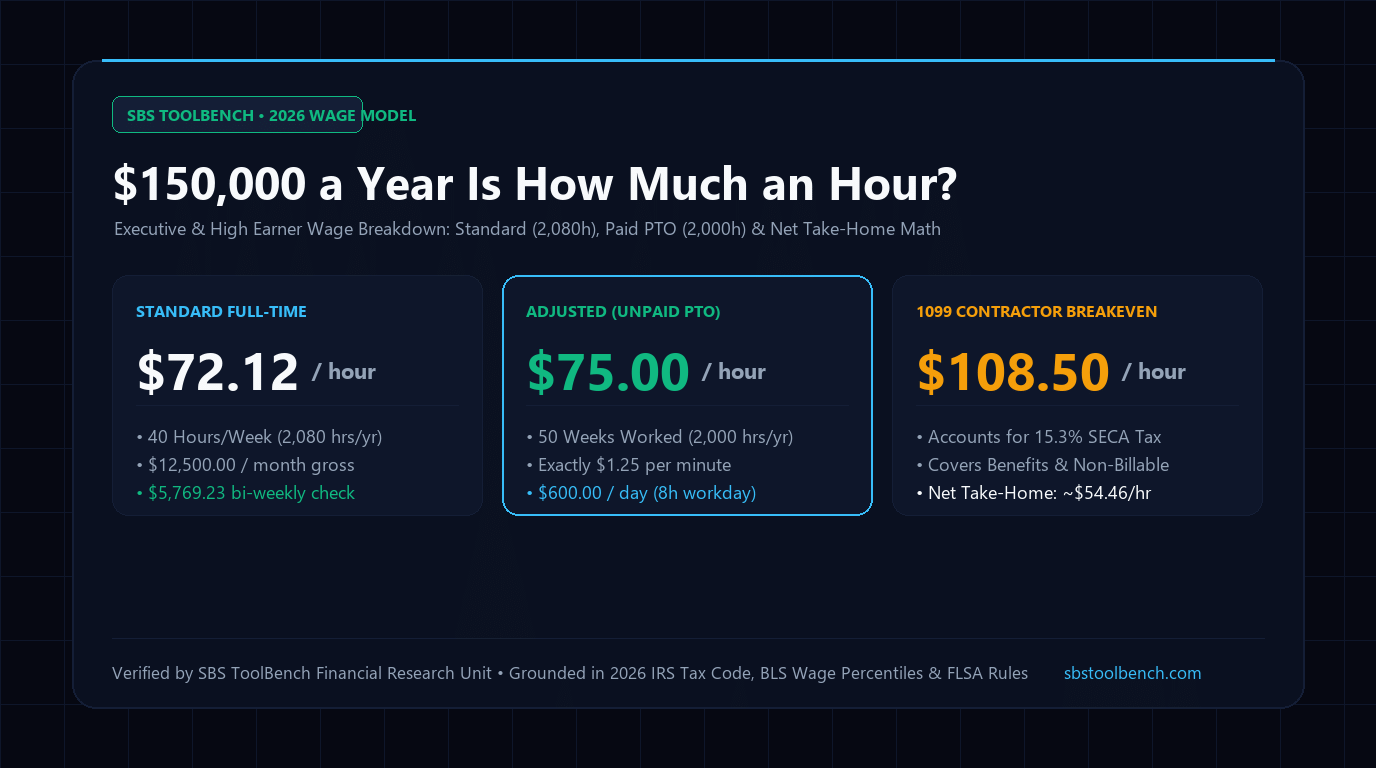
An annual salary of $150,000 translates to an exact gross hourly wage of $72.12 per hour under standard full-time employment (40 hours per week across 52 workweeks, totaling 2,080 hours per year).
However, real-world earnings depend heavily on working arrangements. Salaried tech leaders, corporate directors, and specialized clinicians rarely work a rigid 40-hour schedule. If you log 50 hours per week, your effective hourly earnings decline to $57.69/hour. Conversely, independent contractors billing on a 1099 basis must charge between $105.00 and $115.00/hour to match the net financial value of a $150,000 W-2 package.
2. Comprehensive Second-by-Second to Annual Pay Breakdown
To understand cash flow pacing across every standard payroll frequency, examine the complete mathematical breakdown of a $150,000 annual compensation package based on standard statutory work intervals:
| Pay Interval | Calculation Formula | Gross Earnings (Pre-Tax) | Net Take-Home (0% State Tax)* |
|---|---|---|---|
| Annual (Yearly) | Base salary | $150,000.00 | $113,278.00 |
| Monthly (12 Months) | $150,000 ÷ 12 | $12,500.00 | $9,439.83 |
| Semi-Monthly (24 Checks) | $150,000 ÷ 24 | $6,250.00 | $4,719.92 |
| Bi-Weekly (26 Checks) | $150,000 ÷ 26 | $5,769.23 | $4,356.85 |
| Weekly (52 Weeks) | $150,000 ÷ 52 | $2,884.62 | $2,178.42 |
| Daily (8-Hour Day) | $2,884.62 ÷ 5 | $576.92 | $435.68 |
| Hourly (2,080 Hours) | $150,000 ÷ 2,080 | $72.12 | $54.46 |
| Working Minute | $72.12 ÷ 60 | $1.20 | $0.91 |
| Working Second | $1.20 ÷ 60 | $0.020 | $0.015 |
3. Hours Worked Reality: 2,080 vs 2,000 vs 1,820 Hours
Standard corporate payroll systems rely on 2,080 hours because employees receive paid vacation, sick leave, and holidays. However, when evaluating contractor bids or salaried professional autonomy, the denominator changes significantly:
- Standard Corporate Full-Time (2,080 Hours): 40 hours/week × 52 weeks = $72.12 per hour. Assumes your 2 to 4 weeks of Paid Time Off (PTO) are fully funded by your employer.
- Unpaid Time Off / Contractor Model (2,000 Hours): 40 hours/week × 50 weeks (accounting for 2 weeks unpaid vacation) = $75.00 per hour ($1.25 per minute). If you take 4 weeks unpaid leave (1,920 hours), your rate rises to $78.13 per hour.
- European & Modern Tech Standard (1,820 Hours): 35 hours/week × 52 weeks = $82.42 per hour. Represents progressive professional firms and European enterprise branches operating under 35-hour workweeks.
- Overtime Multipliers (FLSA Non-Exempt Tech/Healthcare):
- Time-and-a-half (1.5×): $108.18 per hour
- Double-time (2.0×): $144.24 per hour
4. 2026 Federal, FICA & State Take-Home Pay Models
A gross compensation of $150,000 places a single earner squarely into the 24% marginal federal tax bracket. Here is the exact mathematical modeling for a single filer claiming the 2026 standard deduction ($15,000):
Statutory Deductions on $150,000 Gross Salary
- Federal Taxable Income: $150,000 − $15,000 standard deduction = $135,000.00
- Federal Income Tax:
• 10% on first $11,925 = $1,192.50
• 12% on $11,926 – $48,475 ($36,550) = $4,386.00
• 22% on $48,476 – $103,350 ($54,875) = $12,072.50
• 24% on $103,351 – $135,000 ($31,650) = $7,596.00
→ Total Federal Tax: $25,247.00 (Effective Federal Rate: 16.83%) - Social Security (FICA 6.2%): $150,000 is under the projected 2026 wage base ($176,100) = $9,300.00
- Medicare (FICA 1.45%): 1.45% on $150,000 = $2,175.00 (exempt from the 0.9% high-earner surtax which triggers at $200k)
- Total Mandatory Federal & FICA Deductions: $36,722.00 (24.48% of gross)
Where you live dramatically alters what lands in your personal checking account. Compare take-home pay across key economic jurisdictions:
| State / Jurisdiction | Est. State Income Tax | Annual Net Pay | Monthly Net Pay | Effective Net Hourly |
|---|---|---|---|---|
| Texas / Florida / Washington (0% State Tax) | $0.00 | $113,278.00 | $9,439.83 | $54.46 / hr |
| Illinois (Flat 4.95%) | ~$7,425.00 | $105,853.00 | $8,821.08 | $50.89 / hr |
| California (Progressive ~7.2% eff.) | ~$10,850.00 | $102,428.00 | $8,535.67 | $49.24 / hr |
| New York (State + NYC Combined ~7.8% eff.) | ~$11,750.00 | $101,528.00 | $8,460.67 | $48.81 / hr |
5. The Salaried Exempt Reality: Overtime & Effective Hourly Rate
At $150,000/year, nearly all corporate employees are classified as FLSA exempt (executive, administrative, or professional exemption). This means your annual pay remains constant regardless of whether you work 35 hours or 65 hours per week.
When evaluating corporate demands and burnout risk, calculate your effective hourly rate:
- 40 hours per week: 2,080 annual hours = $72.12 / hr
- 45 hours per week: 2,340 annual hours = $64.10 / hr
- 50 hours per week: 2,600 annual hours = $57.69 / hr (Drops your real hourly rate to that of a $120,000 worker logging 40 hours)
- 55 hours per week: 2,860 annual hours = $52.45 / hr
- 60 hours per week: 3,120 annual hours = $48.08 / hr (Drops your real earnings to that of a $100,000 worker working 40 hours)
6. 1099 Consultant & Freelancer Breakeven Formula ($109/hr)
A common career question for senior software engineers, financial analysts, and marketing directors is: “If I make $150,000 on a W-2, what hourly rate must I bill on a 1099 contract?”
Billing $72.12/hour as an independent contractor results in a severe financial loss. Contractors bear substantial hidden overhead that W-2 employers normally subsidize:
The 1099 Breakeven Equation for $150k W-2 Parity
1. Self-Employment Tax (SECA 15.3%): Full employer + employee FICA burden adds roughly $10,500 in extra tax.
2. Health, Dental & Vision Insurance: Employer subsidies disappear, requiring ~$7,200/year for private group coverage.
3. Retirement Match (4%): Forfeiting employer 401(k) match equals $6,000/year in lost compensation.
4. Unbillable Utilization: Between client development, billing, and PTO (20 days), consultants bill an average of 1,600 hours annually (out of 2,080).
Conclusion: To match the true total compensation of a $150,000 W-2 position, set your 1099 billing floor between $105.00 and $115.00 per hour.
7. Income Progression Ladder & Peer Tier Comparisons
Compare $150,000 per year against neighboring salary tiers across our verified compensation research library:
$150,000 / Year
$72.12 / hr
$5,769 bi-weekly8. 2026 Economic Benchmark & Purchasing Power
According to 2026 US Bureau of Labor Statistics (BLS) and Census Bureau wage data, an individual salary of $150,000 places the earner in the top 9% to 10% of individual income earners nationwide. It is more than double the national median individual wage (~$60,000) and comfortably exceeds the national median household income (~$80,500).
Purchasing power, however, varies dramatically by metropolitan market. In Tier-1 cost-of-living metros (San Francisco, New York, Seattle), $150,000 provides comfortable financial breathing room but may require disciplined budgeting for single-family homeownership. In Tier-2 and Tier-3 markets (Austin, Raleigh, Columbus, Indianapolis), a $150k salary affords top-tier housing, aggressive retirement funding, and substantial discretionary surplus.
9. Frequently Asked Questions (FAQ)
How much is $150,000 a year per month after taxes?
In zero-state-tax states (Texas, Florida, Washington), a single filer takes home approximately $9,439.83 per month net after federal income and FICA taxes. In high-tax states such as California or New York, net monthly take-home pay averages between $8,460 and $8,535 per month.
What is a bi-weekly paycheck for $150k a year?
Based on 26 annual pay periods, your gross bi-weekly paycheck is exactly $5,769.23. After mandatory federal statutory withholdings (single filer standard deduction), net bi-weekly pay is roughly $4,356.85 in no-tax states.
How much does a $150k earner make per day and per second?
Assuming standard 8-hour workdays across 260 working days per year, gross daily earnings equal $576.92 per day, $1.20 per minute, and exactly $0.020 per working second.
What hourly rate equals $150k for an independent 1099 contractor?
To match a $150,000 W-2 package, a 1099 contractor must bill between $105.00 and $115.00 per hour ($109.38/hr baseline) to cover the 15.3% self-employment tax, unsubsidized health benefits, retirement matching, and unbillable business overhead.