
[no_toc]
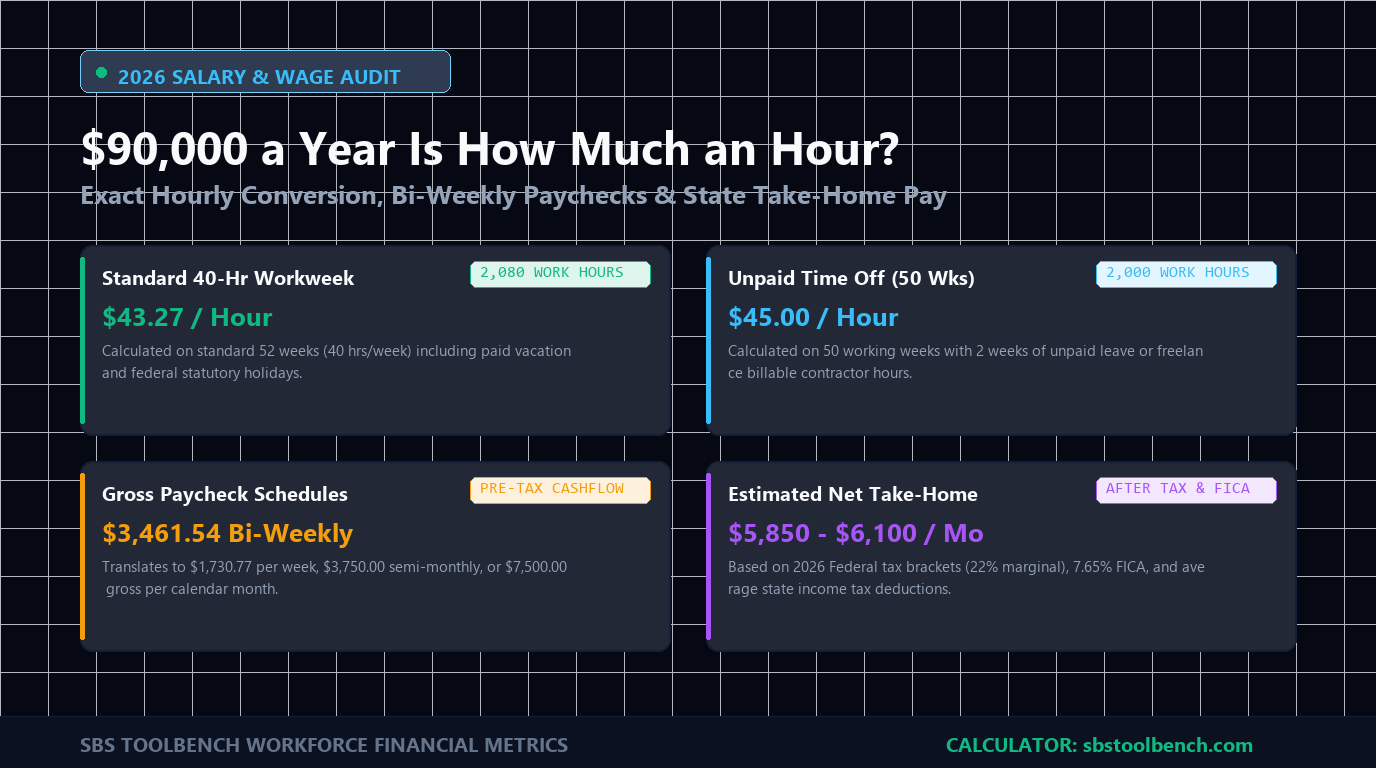
At a standard 40-hour workweek across 52 paid weeks (2,080 working hours per year), $90,000 a year is exactly $43.27 per hour before taxes. If your position includes 2 weeks of unpaid vacation (2,000 working hours), your effective rate rises to $45.00 per hour.
📑 Quick Navigation: Table of Contents (Click to Expand)
- 1. $90k Hourly Breakdown Table (All Pay Periods)
- 2. Standard 2,080 Hours vs. 2,000 Hours (Paid vs. Unpaid PTO)
- 3. What Is $90,000 After Taxes? (Federal, FICA & State Comparison)
- 4. Overtime Rates & 1099 Contractor Equivalency
- 5. How $90k Compares to $80k, $100k, and Median US Wages
- 6. Frequently Asked Questions (2026 Paycheck FAQ)
1. $90k Hourly Breakdown Table (All Pay Periods)
Converting a fixed annual wage of $90,000 into different payroll cycles depends directly on how many weeks and hours are factored into your employment agreement. Below is the full mathematical distribution across standard full-time payroll schedules:
| Pay Frequency | Calculation Formula | Gross Pay (Pre-Tax) |
|---|---|---|
| Hourly (Standard 2,080 hrs) | $90,000 ÷ 2,080 hours | $43.27 / hr |
| Hourly (Adjusted 2,000 hrs) | $90,000 ÷ 2,000 hours | $45.00 / hr |
| Daily (8 Hours / Day) | $43.27 × 8 hours | $346.15 / day |
| Weekly (52 Weeks) | $90,000 ÷ 52 weeks | $1,730.77 / week |
| Bi-Weekly (26 Paychecks) | $90,000 ÷ 26 pay periods | $3,461.54 / paycheck |
| Semi-Monthly (24 Paychecks) | $90,000 ÷ 24 pay periods | $3,750.00 / paycheck |
| Monthly (12 Calendar Months) | $90,000 ÷ 12 months | $7,500.00 / month |
Need Custom Overtime or Part-Time Calculations?
Test custom working hours, 401(k) deductions, and state tax exemptions instantly in our free tool.
2. Standard 2,080 Hours vs. 2,000 Hours (Paid vs. Unpaid PTO)
The exact hourly conversion of a $90k salary depends heavily on how your company handles paid time off (PTO) and federal statutory holidays:
- Standard Salaried Employee (2,080 Hours): If your employment contract grants paid holidays and paid vacation days, you are compensated for 52 full weeks (40 hours × 52 weeks = 2,080 total paid hours). Dividing $90,000 by 2,080 results in $43.27 per hour.
- Unpaid Vacation / Contractor Model (2,000 Hours): If you work as a 1099 independent contractor or take 2 weeks of unpaid leave annually, your working year comprises only 50 weeks (40 hours × 50 weeks = 2,000 actual hours worked). In this case, your hourly billing rate must be at least $45.00 per hour to hit an annual $90,000 target.
- 35-Hour Workweek (1,820 Hours): Certain corporate, legal, or European-aligned organizations operate on a 35-hour workweek. At 1,820 hours per year, a $90k salary translates to $49.45 per hour.
3. What Is $90,000 After Taxes? (Federal, FICA & State Comparison)
Earning $90,000 puts an individual in the upper tier of US median household earnings. However, net take-home pay is significantly reduced by mandatory payroll withholdings:
- Federal Income Tax (2026 Brackets): For a single filer taking the standard deduction, the effective federal tax rate on $90k is approximately 13.5% to 14.5% (with marginal income falling into the 22% federal bracket).
- FICA Taxes: Social Security tax (6.2% on all wages up to the wage base) plus Medicare tax (1.45%) totals an exact mandatory 7.65% ($6,885 per year).
- State Income Tax: Depending on your state of residence, state income taxes range from 0% to over 6%.
| State Classification | Sample States | Estimated Annual Take-Home | Monthly Net Paycheck |
|---|---|---|---|
| Zero State Income Tax | Texas, Florida, Washington, Nevada, Tennessee | ~$71,200 – $72,500 | ~$5,930 – $6,040 / mo |
| Moderate State Income Tax | Illinois, Colorado, Georgia, North Carolina | ~$67,800 – $69,200 | ~$5,650 – $5,765 / mo |
| High State Income Tax | California, New York, New Jersey, Oregon | ~$64,500 – $66,000 | ~$5,375 – $5,500 / mo |
Note: These figures assume single filer status with the standard deduction and do not account for pre-tax deductions such as 401(k), HSA, or health insurance premiums. For deep tax analysis, review our State Income Tax Take-Home Pay Comparison Guide.
4. Overtime Rates & 1099 Contractor Equivalency
For non-exempt employees eligible for overtime pay under the Fair Labor Standards Act (FLSA), an hourly baseline of $43.27 qualifies for premium rates:
- Time and a Half (1.5x Base Rate): $43.27 × 1.5 = $64.91 per overtime hour. Working just 5 hours of overtime per week increases your annual income by over $16,800 to nearly $106,800.
- Double Time (2.0x Base Rate): $43.27 × 2.0 = $86.54 per overtime hour for qualifying weekend, holiday, or emergency shifts. For a detailed comparison, explore our guide on Double Time vs. Time and a Half Overtime.
- 1099 Freelance / Contractor Benchmark: If you transition from a W-2 salaried role to 1099 independent contractor status, you must pay both employer and employee portions of FICA (15.3% self-employment tax) and self-fund health insurance and PTO. To match the purchasing power of a $90k W-2 job, your contractor rate should be at least $55.00 to $65.00 per hour.
5. How $90k Compares to $80k, $100k, and Median US Wages
Understanding where $90,000 sits in relation to adjacent milestone salaries allows professionals to evaluate job promotions and wage negotiations effectively:
$80,000 a Year
$38.46 / hr ($3,076 bi-weekly). Stepping up to $90k yields an extra $4.81/hr or $384 bi-weekly gross.
$90,000 a Year
$43.27 / hr ($3,461 bi-weekly). Sits ~30% higher than US individual median wage.
$100,000 a Year
$48.08 / hr ($3,846 bi-weekly). An additional $4.81/hr crosses the six-figure threshold.
6. Frequently Asked Questions (2026 Paycheck FAQ)
How much is $90,000 a year per day?
Assuming an 8-hour workday and 260 workdays per year, $90,000 a year equals $346.15 per day before taxes.
How much is $90k bi-weekly after taxes?
On a gross bi-weekly paycheck of $3,461.54, an individual in a state with no income tax (like Texas or Florida) takes home approximately $2,740 to $2,790 per paycheck. In higher-tax states like California or New York, net take-home averages $2,480 to $2,540 per paycheck.
Is $90,000 a good salary in 2026?
Yes. According to US Bureau of Labor Statistics data, $90,000 places a single earner comfortably in the top 25% of individual income earners nationwide. It offers substantial financial breathing room in low-to-medium cost of living areas, though housing costs require careful budgeting in tier-1 metro areas like San Francisco, Seattle, and New York.
What is the monthly paycheck for $90,000 a year?
The gross pre-tax monthly salary on a $90,000 annual wage is exactly $7,500.00 per month ($90,000 ÷ 12 months). After federal, FICA, and state tax deductions, net monthly take-home pay averages between $5,500 and $6,050 per month.