
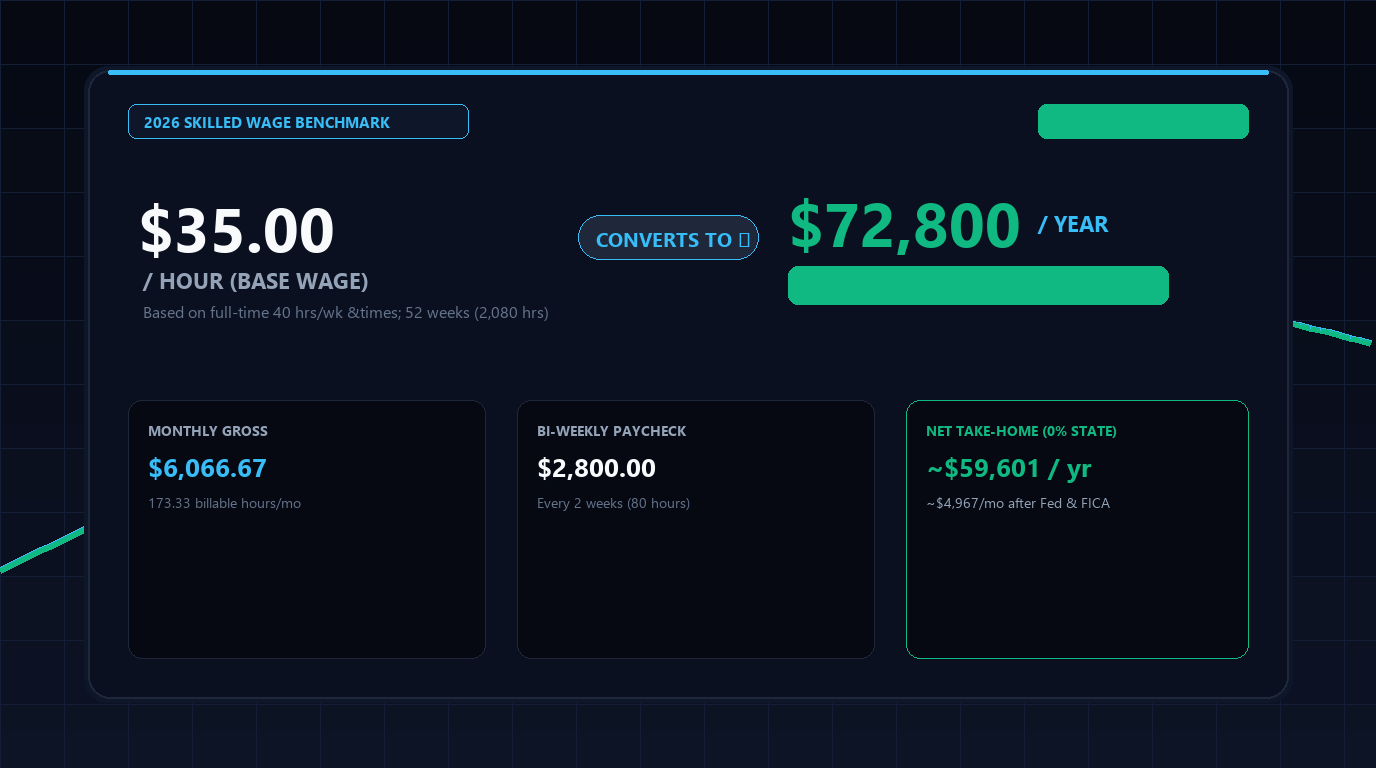
If you earn $35.00 per hour and work a standard full-time schedule of 40 hours per week, your annual gross salary is $72,800 per year before taxes and payroll withholdings. Making $35 an hour represents a solid skilled wage across North America, placing an individual comfortably above the national median individual income and matching the median US household earnings.
🧮 Need Custom Overtime, Unpaid Holidays, or State Tax Deductions?
Plug your specific hourly rate, state residency, and 401(k) retirement contributions directly into our live interactive calculator for instant real-time results.
Launch Free Hourly to Salary Converter →Table of Contents (Click to Expand)
- 1. The Core Calculation: How $35/Hour Becomes $72,800/Year
- 2. Paid Time Off vs Unpaid Vacation: The 2,080 vs 2,000 Hours Distinction
- 3. $35 an Hour Converted Across All Paycheck Frequencies
- 4. Part-Time Schedules: 20, 25, 30, and 35 Hours per Week
- 5. Exact 2026 Taxes & Net Take-Home Pay ($35/Hr After Taxes)
- 6. How to Live on $35 an Hour: Realistic 50/30/20 Monthly Budget
- 7. Is $35 an Hour Good Pay in 2026? US Living Cost & Real Purchasing Power
- 8. Overtime Calculations ($52.50/Hour FLSA Time-and-a-Half)
- 9. Hourly Wage Comparison Context (The Salary Ladder)
- 10. Frequently Asked Questions (FAQ)
1. The Core Calculation: How $35/Hour Becomes $72,800/Year
Under standard US payroll guidelines, a full-time working year consists of 52 weeks. An employee working 40 hours per week accumulates 2,080 working hours annually:
2,080 hours × $35.00/hour = $72,800.00 Gross Annual Income
This $72,800 amount represents your gross annual earnings before mandatory tax deductions (federal income tax, Social Security, Medicare, and state taxes) as well as employer benefits withholdings.
2. Paid Time Off vs Unpaid Vacation: The 2,080 vs 2,000 Hours Distinction
Your actual gross earnings vary based on whether your employment includes paid time off (PTO) or if you work as a contractor who takes unpaid breaks:
If you take two weeks of unpaid leave, you earn exactly $70,000 a year across 2,000 billable hours.
3. $35 an Hour Converted Across All Paycheck Frequencies
Here is how a $35/hour pay rate converts across each standard payroll distribution frequency:
4. Part-Time Schedules: 20, 25, 30, and 35 Hours per Week
Working fewer hours at $35/hour provides significant lifestyle flexibility while maintaining solid earning power:
5. Exact 2026 Taxes & Net Take-Home Pay ($35/Hr After Taxes)
Below is the exact 2026 federal and FICA payroll tax withholding schedule for a single individual claiming the standard deduction ($15,000 for single filers in 2026):
Federal & FICA Deductions Breakdown (2026 IRS Rules)
- Gross Annual Income: $72,800.00
- 2026 Single Standard Deduction: -$15,000.00
- Federal Taxable Income: $57,800.00
- Federal Income Tax (10%, 12%, 22% brackets): -$7,630.00 (Effective rate ~10.48%)
- FICA – Social Security (6.2% on $72,800): -$4,513.60
- FICA – Medicare (1.45% on all earnings): -$1,055.60
- Total Mandatory Federal Withholding: -$13,199.20 (18.13% of gross)
State tax obligations alter net take-home pay based on your geographic location:
6. How to Live on $35 an Hour: Realistic 50/30/20 Monthly Budget
In a zero income tax state with approximately $4,967 per month in net take-home pay, following the classic 50/30/20 budget framework ensures consistent wealth generation and financial protection:
50% Needs: $2,483 / month
- Rent / Mortgage: $1,400 – $1,650
- Utilities & High-Speed Internet: $230
- Groceries: $450
- Car Payment, Gas & Insurance: $353
30% Wants: $1,490 / month
- Dining Out & Takeout: $450
- Travel & Flights: $350
- Subscriptions & Memberships: $100
- Shopping & Apparel: $250
- Entertainment & Hobbies: $340
20% Savings & Debt: $993 / month
- Roth IRA: $583 (Maxed $7k/yr limit)
- Employer 401(k) / Emergency Savings: $410
- Annual Wealth Accumulation: $11,916 / year
7. Is $35 an Hour Good Pay in 2026? US Living Cost & Real Purchasing Power
Yes. A $35 per hour wage ($72,800/year) ranks in the top 33% of individual income earners nationwide. It comfortably outpaces the US median individual wage (~$48,000) and matches the US median household income ($74,580), allowing a single worker to match the buying power of typical two-earner households.
In low and mid-cost of living regions (such as San Antonio, Cleveland, Indianapolis, or Tampa), $35/hour provides comfortable middle-class homeownership opportunities with mortgage budgets up to $260,000 to $330,000.
8. Overtime Calculations ($52.50/Hour FLSA Time-and-a-Half)
Under the Fair Labor Standards Act (FLSA), non-exempt hourly employees working beyond 40 hours in a single standard workweek are entitled to 1.5 times their regular hourly rate. For a $35/hour worker, overtime pays $52.50 per hour:
9. Hourly Wage Comparison Context (The Salary Ladder)
To see how a career promotion or raise negotiation stacks up, compare $35 an hour against adjacent benchmarks across our workforce reference library:
$70,000 a Year Is How Much an Hour? →
10. Frequently Asked Questions (FAQ)
How much is $35 an hour a year?
Assuming a standard 40-hour workweek for 52 weeks (2,080 hours), $35 an hour equals $72,800 per year before taxes. If you take two weeks of unpaid vacation (2,000 hours), it equals exactly $70,000 per year.
How much is $35 an hour bi-weekly?
Across 26 annual pay periods, your gross bi-weekly paycheck is exactly $2,800.00 (80 hours × $35). After 2026 federal and FICA payroll taxes, net take-home is roughly $2,292.34 bi-weekly in a no-tax state, or roughly $2,096.34 in a high-tax state.
How much is $35 an hour after taxes?
For a single filer in 2026 taking the standard deduction, federal income tax is approximately $7,630 and FICA taxes equal $5,569.20. In states with no income tax (such as Texas or Florida), your net take-home pay is approximately $59,601 per year (~$4,967/month). In states with moderate taxes, net pay is ~$56,325, and in high-tax states like CA or NY, net pay is ~$54,505.
How much is $35 an hour per month?
Before taxes, $35 an hour yields an average gross monthly income of $6,066.67 ($72,800 divided by 12 months). After standard federal and FICA withholdings, net monthly take-home is approximately $4,966.73 in a no-tax state.
Can you buy a house making $35 an hour?
Yes. With a $72,800 annual gross salary, standard banking guidelines under the 28% rule permit up to $1,698 in monthly mortgage payments, qualifying you for home purchases between $260,000 and $330,000 across many US housing markets.