
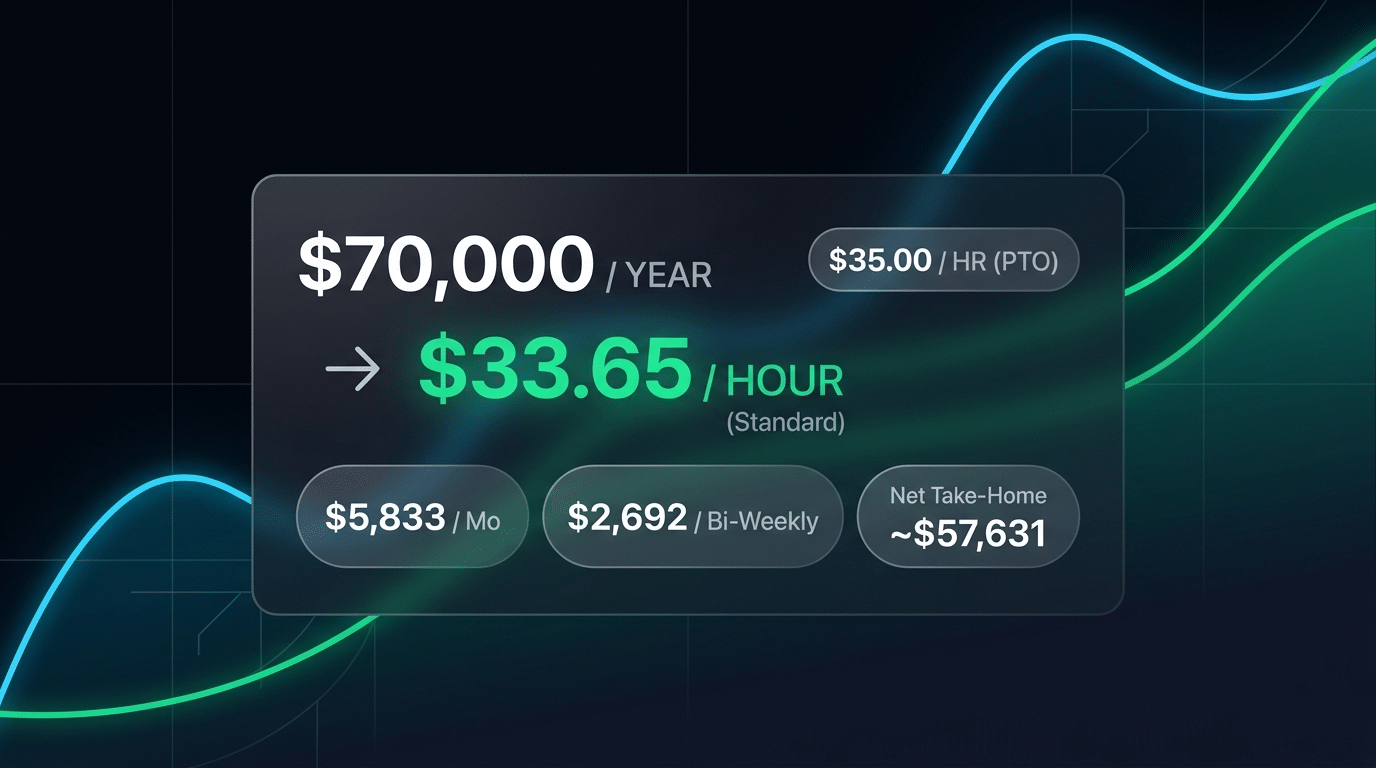
An annual salary of $70,000 per year converts to approximately $33.65 per hour based on a standard 40-hour workweek across 52 weeks (2,080 working hours). If your employment package includes two weeks of paid time off (PTO) or you calculate your earnings over 50 actual working weeks (2,000 working hours), your effective rate rises to exactly $35.00 per hour.
🧮 Want to Convert a Specific Salary or Hourly Wage?
Switch effortlessly between annual salaries, hourly wages, overtime multipliers, and state-specific tax deductions with our instant online calculator.
Launch Free Hourly to Salary Converter →Table of Contents (Click to Expand)
- 1. The Core Calculation: How $70,000 Converts to Hourly Pay
- 2. Paid Time Off (PTO) vs Unpaid Leave: $33.65 vs $35.00 per Hour
- 3. $70,000 Broken Down Across All Pay Frequencies
- 4. Hourly Equivalent on Alternative Work Schedules (30h, 35h, 45h, 50h)
- 5. Exact 2026 Taxes & Net Take-Home Pay ($70k After Taxes)
- 6. How to Live on $70,000 a Year: Realistic 50/30/20 Monthly Budget
- 7. Is $70,000 a Good Salary in 2026? US Benchmarks & Purchasing Power
- 8. Exempt vs Non-Exempt Salaried Workers & Overtime Eligibility
- 9. Top Occupations & Careers That Pay Around $70,000
- 10. Related Wage & Salary Benchmarks (The Salary Ladder)
- 11. Frequently Asked Questions (FAQ)
1. The Core Calculation: How $70,000 Converts to Hourly Pay
To convert an annual salaried income of $70,000 into its equivalent hourly rate, you divide the annual gross salary by the total number of paid hours in a calendar year. Under standard full-time US accounting (40 hours per week across 52 weeks), the total working hours equal 2,080 hours:
This $33.65 per hour figure represents your unadjusted base rate. It is the exact number corporate payroll departments and recruiters use when structuring compensation offers, hourly consulting rates, and contract conversions.
2. Paid Time Off (PTO) vs Unpaid Leave: $33.65 vs $35.00 per Hour
The distinction between working hours and paid hours is critical when transitioning between salaried corporate employment and hourly or freelance contracting:
3. $70,000 Broken Down Across All Pay Frequencies
Here is how a $70,000 base salary distributes across the standard US payroll pay schedules:
4. Hourly Equivalent on Alternative Work Schedules (30h, 35h, 45h, 50h)
If your job requires more or fewer than 40 hours per week, your actual hourly rate changes considerably:
5. Exact 2026 Taxes & Net Take-Home Pay ($70k After Taxes)
Gross salary determines company expense, but net pay dictates personal lifestyle. Below is the 2026 tax withholding calculation for an unmarried individual taking the standard deduction:
Federal & FICA Deductions Breakdown (2026 IRS Rules)
- Gross Annual Salary: $70,000.00
- 2026 Single Standard Deduction: -$15,000.00
- Federal Taxable Income: $55,000.00
- Federal Income Tax (10%, 12%, 22% brackets): -$7,014.00 (Effective rate ~10.02%)
- FICA – Social Security (6.2%): -$4,340.00
- FICA – Medicare (1.45%): -$1,015.00
- Total Mandatory Federal Withholding: -$12,369.00 (17.67% of gross)
State taxes further alter take-home pay based on your geographic location:
6. How to Live on $70,000 a Year: Realistic 50/30/20 Monthly Budget
In a state with no income tax, an individual earning $70,000 has roughly $4,803 per month in net take-home pay. Applying the standard 50/30/20 budgeting rule balances essential costs and personal savings:
50% Needs: $2,401 / month
- Rent / Mortgage: $1,350 – $1,600
- Utilities & Phone: $220
- Groceries: $450
- Transportation & Gas: $300
- Health & Car Insurance: $231
30% Wants: $1,441 / month
- Dining Out & Takeout: $400
- Vacations & Travel: $350
- Subscriptions & Memberships: $90
- Shopping & Personal Care: $250
- Entertainment & Hobbies: $351
20% Savings & Debt: $961 / month
- Roth IRA: $583 (Max $7k annual limit)
- 401(k) / Emergency Fund: $378
- Annual Wealth Accumulation: $11,532 / year
7. Is $70,000 a Good Salary in 2026? US Benchmarks & Purchasing Power
Yes. Earning $70,000 annually as an individual places you approximately in the 65th percentile of individual US wage earners, meaning you make more than nearly two-thirds of the American workforce. It closely matches the US median household income ($74,580), achieving single-handedly what typically requires two average earners to produce.
In low and mid-cost of living areas (such as Ohio, Texas, Indiana, or North Carolina), $70,000 provides excellent financial security, reliable vehicle ownership, annual vacations, and eligibility for home mortgages in the $250,000 to $320,000 range.
8. Exempt vs Non-Exempt Salaried Workers & Overtime Eligibility
Under the US Department of Labor’s Fair Labor Standards Act (FLSA), employees earning a salary of $70,000 generally meet the salary threshold test for “exempt” executive, administrative, or professional status. If you are classified as exempt, your employer pays you a fixed $70,000 regardless of whether you work 35 hours or 55 hours in a given week, with no overtime pay.
If your role is classified as non-exempt, your base rate of $33.65 entitles you to time-and-a-half ($50.48 per hour) for every hour worked beyond 40 per week, generating up to $252.40 per week for just 5 hours of weekly overtime ($13,124 extra gross annually).
9. Top Occupations & Careers That Pay Around $70,000
A $70,000 compensation package is common among established mid-level professional occupations, including:
- Digital Marketing & SEO Managers: $68,000 – $76,000
- Staff Accountants & Financial Auditors: $65,000 – $74,000
- Associate Project Managers & Scrum Masters: $68,000 – $75,000
- Entry-Level Cybersecurity Analysts: $70,000 – $78,000
- Human Resources Generalists & Senior Recruiters: $66,000 – $72,000
- Commercial Electricians & HVAC Technicians: $65,000 – $74,000
10. Related Wage & Salary Benchmarks (The Salary Ladder)
Explore adjacent compensation tiers in our workforce calculator library:
11. Frequently Asked Questions (FAQ)
How much is $70,000 a year per hour?
Assuming a standard 40-hour workweek for 52 weeks (2,080 hours), $70,000 per year equals exactly $33.65 per hour. If you receive two weeks of unpaid vacation or evaluate actual working time over 2,000 hours, it equals $35.00 per hour.
How much is a $70,000 salary bi-weekly?
Across 26 annual pay periods, your gross bi-weekly paycheck is $2,692.31. After mandatory 2026 federal and FICA taxes, net take-home bi-weekly pay is approximately $2,216.58 in a no-tax state, or roughly $2,041.58 in a high-tax state.
What is $70k a year after taxes?
In 2026, a single filer pays approximately $7,014 in federal income tax and $5,355 in FICA taxes (Social Security + Medicare). In states with zero income tax, your net take-home pay is roughly $57,631 per year (~$4,803 per month). In states with moderate taxes, net pay is ~$54,691, and in high-tax states like CA or NY, net pay is ~$53,081.
Can you live comfortably on $70,000 a year?
Yes. In the majority of US cities, $70,000 allows a single adult to live comfortably, maintain a car, save over $10,000 annually, and afford a good quality apartment. In top-tier expensive cities (NYC, SF, Boston), living comfortably on $70,000 may require roommates or living slightly farther from downtown cores.
What is $70k a year broken down monthly?
Before taxes, $70,000 equals exactly $5,833.33 per month ($70,000 divided by 12 months). After standard federal and FICA payroll taxes, net monthly take-home is approximately $4,802.58 in a no-tax state.