
📑 Quick Navigation: Table of Contents
1. Quick Answer: $30k a Year Is How Much an Hour?
2. Comprehensive Second-by-Second to Annual Pay Breakdown
3. Hours Worked Reality: 2,080 vs 2,000 vs 1,820 Hours
4. 2026 Federal, FICA & State Take-Home Pay Models
5. Overtime & Multiplier Rates (FLSA Non-Exempt)
6. 1099 Freelance & Gig Economy Rate ($22.50/hr)
7. Wage Milestone Ladder: Next Career Steps
1. Quick Answer: $30k a Year Is How Much an Hour?
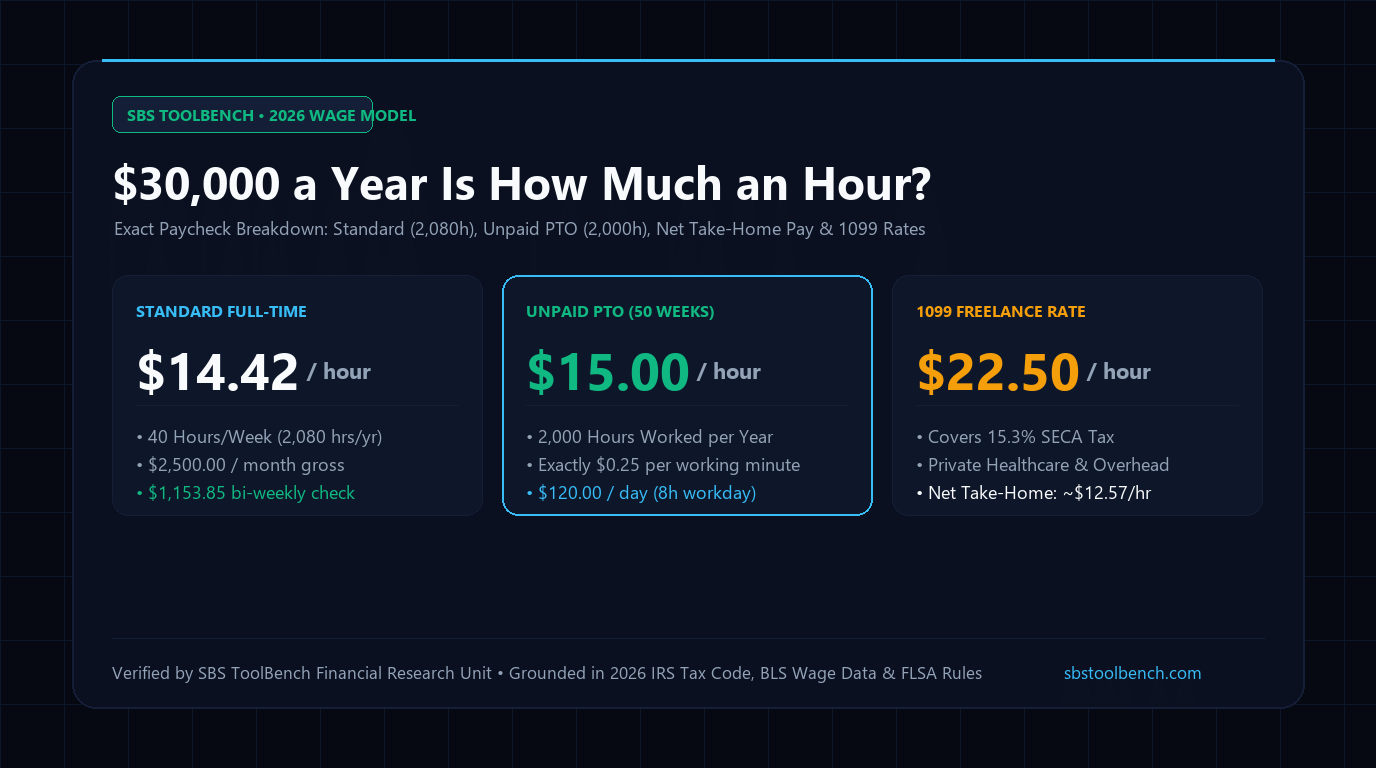
An annual salary of $30,000 breaks down to a gross wage of $14.42 per hour for a standard full-time schedule of 40 hours per week across 52 workweeks (2,080 working hours per year).
If your employer does not offer paid vacation and you take 2 weeks of unpaid time off (working 50 weeks or 2,000 hours per year), your actual working hourly rate becomes an even $15.00 per hour ($0.25 per working minute). For independent 1099 contractors or gig platform workers, billing $14.42/hr results in net poverty after self-employment tax; you must bill at least $21.50 to $24.00 per hour to match a $30,000 W-2 job.
2. Comprehensive Second-by-Second to Annual Pay Breakdown
Here is the complete statutory payroll cash flow conversion for a $30,000 annual wage across all standard payment frequencies:
| Pay Interval | Calculation Formula | Gross Earnings (Pre-Tax) | Net Take-Home (0% State Tax)* |
|---|---|---|---|
| Annual (Yearly) | Base salary | $30,000.00 | $26,143.50 |
| Monthly (12 Months) | $30,000 ÷ 12 | $2,500.00 | $2,178.63 |
| Semi-Monthly (24 Checks) | $30,000 ÷ 24 | $1,250.00 | $1,089.31 |
| Bi-Weekly (26 Checks) | $30,000 ÷ 26 | $1,153.85 | $1,005.52 |
| Weekly (52 Weeks) | $30,000 ÷ 52 | $576.92 | $502.76 |
| Daily (8-Hour Day) | $576.92 ÷ 5 | $115.38 | $100.55 |
| Hourly (2,080 Hours) | $30,000 ÷ 2,080 | $14.42 | $12.57 |
| Working Minute | $14.42 ÷ 60 | $0.240 | $0.209 |
| Working Second | $0.240 ÷ 60 | $0.004 | $0.0035 |
3. Hours Worked Reality: 2,080 vs 2,000 vs 1,820 Hours
Depending on how your working weeks and vacation policies are structured, your true hourly value shifts:
- Standard Full-Time (2,080 Hours): 40 hours/week × 52 weeks = $14.42 per hour. Assumes paid holidays and vacation.
- Unpaid Time Off (2,000 Hours): 40 hours/week × 50 weeks (2 weeks unpaid PTO) = $15.00 per hour ($0.25/minute).
- Part-Time Professional (1,820 Hours): 35 hours/week × 52 weeks = $16.48 per hour.
- Half-Time Schedule (1,040 Hours): 20 hours/week × 52 weeks = $28.85 per hour.
4. 2026 Federal, FICA & State Take-Home Pay Models
At $30,000 annual gross income, single earners benefit from low effective tax rates due to the progressive tax code and the 2026 standard deduction:
Statutory Deductions Breakdown on $30,000 Salary
- Federal Taxable Income: $30,000 − $15,000 standard deduction = $15,000.00
- Federal Income Tax:
• 10% on first $11,925 = $1,192.50
• 12% on remaining $3,075 ($11,926 to $15,000) = $369.00
→ Total Federal Income Tax: $1,561.50 (Effective Federal Rate: 5.21%) - Social Security (FICA 6.2%): 6.2% on $30,000 = $1,860.00
- Medicare (FICA 1.45%): 1.45% on $30,000 = $435.00
- Total Mandatory Federal & FICA Taxes: $3,856.50 (12.86% of gross)
5. Overtime & Multiplier Rates (FLSA Non-Exempt)
Under the Fair Labor Standards Act (FLSA), an earner making $30,000/year is non-exempt from overtime because this salary falls below the standard salary exemption threshold. Any hours worked beyond 40 hours in a single workweek must be compensated at overtime rates:
- Base Regular Hourly Rate: $14.42 per hour
- Time-and-a-Half (1.5× Overtime): $21.63 per hour (+$7.21/hr premium)
- Double-Time (2.0× Holiday/Seventh Consecutive Day): $28.84 per hour (+$14.42/hr premium)
- Example: Working just 5 hours of overtime per week adds $108.15 gross weekly ($5,623.80/year), raising your annual compensation to over $35,600!
6. 1099 Freelance & Gig Economy Rate ($22.50/hr)
If you are working on 1099 contracts (rideshare, delivery, freelance virtual assisting, or customer care), billing $14.42/hour leaves you at a severe deficit. Independent contractors must fund their own payroll taxes and benefits:
The 1099 Breakeven Calculation for $30,000 Parity
• Self-Employment Tax (SECA 15.3%): ~$4,238 in self-employment taxes (both employer and employee portions).
• Healthcare & Overhead: Private health coverage and equipment maintenance costs roughly ~$3,500/year.
• Unbillable Time: Factoring in unpaid sick days and administrative work, full-time freelancers average ~1,600 billable hours per year.
Bottom Line: To net the same purchasing power as a $30,000 W-2 employee, your 1099 hourly rate must be at least $21.50 to $24.00 per hour.
7. Wage Milestone Ladder: Next Career Steps
See how advancing from $30,000/year shifts your hourly earnings and take-home pay:
$30,000 / Year
$14.42 / hr
$1,154 bi-weekly8. Living on $30k: Budgeting, Purchasing Power & EITC
With a monthly net take-home of approximately $2,178.63 in zero-state-tax states, managing personal finances on $30,000 requires strict structural budgeting:
- Housing Rule (30% Rule): Target rent or mortgage should ideally stay under $650 to $750 per month (achievable in low cost-of-living areas or with roommates).
- Earned Income Tax Credit (EITC): If you are raising a child as a single parent on $30k, you may qualify for substantial refundable federal tax credits (up to ~$4,213 in 2026), significantly boosting your annual net cash flow.
- Emergency Reserves: Saving just $100 per bi-weekly paycheck builds a $2,600 emergency safety cushion over 12 months.
9. Frequently Asked Questions (FAQ)
How much is $30,000 a year per month after taxes?
In states without state income tax (Texas, Florida, Washington, etc.), take-home pay is roughly $2,178.63 per month net after federal income and FICA taxes. In states with state income tax (like California or New York), net monthly pay ranges from $2,090 to $2,135 per month.
What is a bi-weekly paycheck for $30k a year?
Over 26 pay periods, a $30,000 salary yields a gross bi-weekly paycheck of $1,153.85. After statutory federal deductions (single filer standard deduction), net bi-weekly pay is approximately $1,005.52.
How much is $30,000 a year per hour with 2 weeks unpaid vacation?
If you work 50 weeks per year (2,000 hours total), $30,000 equals exactly $15.00 per hour ($0.25 per working minute).
Is $30,000 a year above the federal minimum wage?
Yes. At $14.42 per hour, a $30,000 salary is nearly double the US federal minimum wage ($7.25/hr), although it is close to state minimum wages in progressive states such as California ($16.00/hr) and New York ($16.00/hr).