
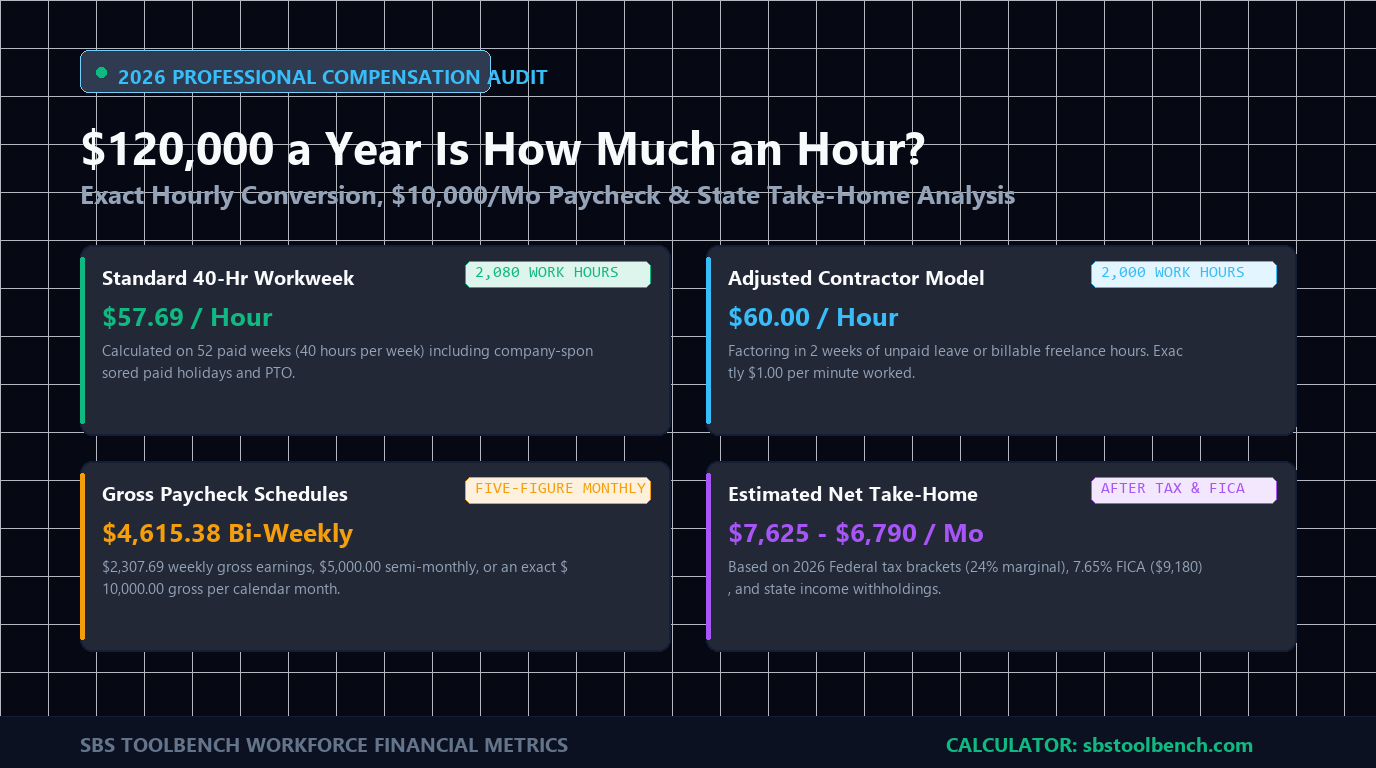
At a standard 40-hour workweek across 52 paid weeks (2,080 working hours annually), $120,000 a year is exactly $57.69 per hour before taxes. If your compensation model excludes paid time off (2,000 working hours with 2 weeks of unpaid leave), your effective billing rate is exactly $60.00 per hour ($1.00 per minute).
📑 Quick Navigation: Table of Contents (Click to Expand)
- 1. Complete $120k Pay Period Breakdown (From Second to Year)
- 2. Workweek Hours Impact: 2,080 vs. 2,000 vs. 1,820 Hours
- 3. What Is $120,000 After Taxes? (Federal, FICA & State Comparison)
- 4. W-2 Employee vs. 1099 Independent Contractor Rate ($81.25/Hr Rule)
- 5. Overtime Rates: Time and a Half ($86.54) & Double Time ($115.38)
- 6. Is $120k a Good Salary in 2026? (Cost of Living & Occupations)
- 7. Salary Progression Ladder: $90k vs. $100k vs. $120k vs. $150k
- 8. Frequently Asked Questions (2026 Compensation FAQ)
1. Complete $120k Pay Period Breakdown (From Second to Year)
An annual compensation package of $120,000 represents an iconic milestone in corporate and professional careers. Breaking this six-figure benchmark into standard payroll cycles gives you a clear baseline for negotiating salary offers, consulting retainers, and overtime rates:
| Timeframe | Mathematical Formula | Gross Amount (Pre-Tax) |
|---|---|---|
| Per Second | $57.69 ÷ 3,600 seconds | $0.016 / sec |
| Per Minute | $57.69 ÷ 60 minutes | $0.96 / min |
| Hourly (Standard 2,080 hrs) | $120,000 ÷ 2,080 hours (52 weeks) | $57.69 / hour |
| Hourly (Adjusted 2,000 hrs) | $120,000 ÷ 2,000 hours (50 weeks) | $60.00 / hour |
| Daily (8 Hours) | $57.69 × 8 hours | $461.54 / day |
| Weekly (40 Hours) | $120,000 ÷ 52 weeks | $2,307.69 / week |
| Bi-Weekly (26 Paychecks) | $120,000 ÷ 26 pay periods | $4,615.38 / paycheck |
| Semi-Monthly (24 Paychecks) | $120,000 ÷ 24 pay periods | $5,000.00 / paycheck |
| Monthly (12 Months) | $120,000 ÷ 12 calendar months | $10,000.00 / month |
Test Different Work Hours & State Tax Deductions
Calculate custom weekly schedules, 401(k) pre-tax contributions, and state tax exemptions live.
2. Workweek Hours Impact: 2,080 vs. 2,000 vs. 1,820 Hours
Not all full-time jobs involve the same number of annual working hours. Depending on whether your compensation model provides paid vacation and statutory federal holidays, your effective hourly worth varies considerably:
- Standard Salaried Employee (2,080 Hours): Corporate full-time employees with standard paid time off (PTO) and paid holidays are compensated for all 52 weeks in a calendar year (40 hours/week × 52 weeks = 2,080 hours). Dividing $120,000 by 2,080 yields an exact $57.69 per hour.
- Unpaid Leave or Hourly Contractor (2,000 Hours): If you work as an hourly consultant or receive 2 weeks of unpaid time off (such as taking 10 days of unpaid vacation), your working year consists of 50 active weeks (40 hours/week × 50 weeks = 2,000 hours). At 2,000 hours, your required wage is an even $60.00 per hour.
- 35-Hour Corporate Workweek (1,820 Hours): Many financial firms, law offices, and multinational organizations in the UK and Europe operate on a standard 35-hour workweek (7 hours per day). On this schedule (35 hours × 52 weeks = 1,820 hours), a $120k salary translates to a lucrative $65.93 per hour.
- 45-Hour Heavy Workweek (2,340 Hours): In industries with regular mandatory overtime or executive expectations (45 hours per week across 52 weeks), you log 2,340 hours annually. This effectively dilutes your hourly compensation down to $51.28 per hour.
3. What Is $120,000 After Taxes? (Federal, FICA & State Comparison)
While a gross annual salary of $120,000 provides a healthy $10,000 pre-tax monthly income, payroll deductions significantly impact net liquid earnings:
- Federal Income Tax (2026 Tax Brackets): For a single tax filer taking the standard deduction, the effective federal income tax rate on $120k is approximately 15.8% to 16.5% (roughly $19,200 to $19,800 annually). Marginal income above $100,525 falls into the 24% federal tax bracket.
- FICA Mandatory Payroll Taxes:
- Social Security (6.2%): Exact $7,440.00 per year (capped well below the 2026 statutory wage base).
- Medicare (1.45%): Exact $1,740.00 per year (uncapped).
- Total FICA Withholding: Exactly 7.65% ($9,180.00 per year).
- State Income Tax: Depending on the state where you reside and work, state tax deductions range from 0.0% to over 7.5%.
| Tax Environment | Representative States | Estimated Annual Take-Home | Monthly Net Paycheck | Bi-Weekly Net Pay |
|---|---|---|---|---|
| Zero State Income Tax | Texas, Florida, Washington, Nevada, Tennessee, Wyoming | ~$91,200 – $92,500 | ~$7,600 – $7,710 | ~$3,510 – $3,560 |
| Moderate State Income Tax | Illinois, Colorado, Ohio, North Carolina, Georgia, Arizona | ~$86,000 – $87,500 | ~$7,165 – $7,290 | ~$3,307 – $3,365 |
| High State Income Tax | California, New York, New Jersey, Oregon, Massachusetts | ~$81,500 – $83,200 | ~$6,790 – $6,930 | ~$3,135 – $3,200 |
Tax calculations reflect 2026 IRS single filer tax schedules using the standard deduction. If you maximize pre-tax contributions such as a traditional 401(k) ($23,500 limit in 2026) or Health Savings Account (HSA), you reduce your taxable gross by over $27,000, saving thousands in marginal federal brackets. For complete regional details, explore our State Income Tax Take-Home Pay Guide.
4. W-2 Employee vs. 1099 Independent Contractor Rate ($81.25/Hr Rule)
Many professionals at the $120,000 salary tier receive offers to transition from standard full-time W-2 corporate roles into 1099 freelance or independent contracting engagements. Billing $57.69 per hour on a 1099 contract will result in a significant pay cut due to hidden overhead:
- Self-Employment Tax (SECA): As a 1099 contractor, you must pay both the employee and employer portions of FICA taxes, doubling your obligation to 15.3% on net self-employment earnings.
- Health Insurance & Benefits: Employers typically subsidize 70% to 85% of health, dental, and vision insurance premiums (worth $6,000 to $9,000 annually per employee). On a 1099 agreement, this must be funded 100% out of pocket.
- Unpaid Holidays and PTO: A standard W-2 position provides ~15 days of PTO and 10 paid federal holidays (25 days total, or 5 weeks of paid non-working time). Contractors only bill when actively producing deliverables.
- The 1099 Breakeven Calculation: To match the net take-home pay, benefits, and retirement match of a $120,000 W-2 salaried employee, an independent contractor must generate at least $156,000 to $165,000 in gross annual billings. Assuming 1,920 billable hours per year, your minimum required 1099 rate is $81.25 to $86.00 per billable hour.
5. Overtime Rates: Time and a Half ($86.54) & Double Time ($115.38)
Under the Fair Labor Standards Act (FLSA), most professionals earning $120,000 are classified as exempt under administrative, executive, or professional salary exemptions. However, specialized technical roles, union trades, traveling nurses, and government defense contractors often remain non-exempt and earn premium overtime wages:
- Time and a Half (1.5x FLSA Overtime): $57.69 × 1.5 = $86.54 per overtime hour. Logging 8 hours of weekly overtime yields an extra $692.32 per week, boosting your annual gross compensation by nearly $36,000 to $156,000 per year.
- Double Time (2.0x Premium Rate): $57.69 × 2.0 = $115.38 per overtime hour. Double time applies during mandated holiday shifts, seventh consecutive workdays in states like California, or specialized offshore field work. For complete rules, review our Double Time vs. Time and a Half Overtime Guide.
6. Is $120k a Good Salary in 2026? (Cost of Living & Occupations)
According to 2026 United States Bureau of Labor Statistics (BLS) data, an individual earning $120,000 per year ranks comfortably in the top 15% of individual income earners nationwide and is nearly double the national median individual salary (~$60,000).
However, the purchasing power of $120,000 varies drastically based on geography:
- High Cost of Living (HCOL) Metros (San Francisco, NYC, Boston, Seattle): In cities where median rent for a 1-bedroom apartment exceeds $3,200/month, $120k provides comfortable middle-class living, but purchasing a single-family home or funding private schooling requires dual-income household earnings.
- Medium to Low Cost of Living (MCOL / LCOL) Metros (Dallas, Atlanta, Charlotte, Indianapolis, Tampa): In these growing metro regions, $120,000 offers substantial financial luxury—allowing an individual or family to afford modern single-family home mortgages, build aggressive investment portfolios, and travel comfortably.
Popular Occupations Earning $120,000 in 2026
Technology & Engineering
Senior Full-Stack Developers, Cloud DevOps Architects, Cybersecurity Engineers, Data Scientists.
Healthcare & Medicine
Nurse Practitioners (NP), Physician Assistants (PA), Experienced Pharmacists, Nurse Anesthetists.
Finance & Corporate
Senior Financial Analysts, Corporate Controllers, Commercial Real Estate Brokers, Risk Managers.
Product & Operations
Senior Technical Product Managers, Supply Chain Directors, Construction Project Executives.
7. Salary Progression Ladder: $90k vs. $100k vs. $120k vs. $150k
Comparing $120,000 to adjacent compensation tiers helps professionals evaluate promotional opportunities and equity packages:
$120,000 / Year
$57.69 / hr
$4,615 bi-weekly$150,000 / Year
$72.12 / hr
$5,769 bi-weekly8. Frequently Asked Questions (2026 Compensation FAQ)
How much is $120,000 a year per hour?
Based on a full-time schedule of 40 hours per week across 52 paid weeks (2,080 working hours annually), $120,000 a year equals exactly $57.69 per hour. On a 2,000-hour schedule (with 2 weeks unpaid leave), it equals $60.00 per hour.
What is the monthly paycheck for $120,000 a year?
The gross monthly paycheck is exactly $10,000.00 per month before tax withholdings. After federal income tax, 7.65% FICA contributions, and state income taxes, net monthly take-home pay averages between $6,790 and $7,625 per month depending on your state.
How much is $120k bi-weekly after taxes?
On a gross bi-weekly paycheck of $4,615.38, a single taxpayer in a zero-income-tax state (like Florida, Texas, or Washington) takes home approximately $3,510 to $3,560 every two weeks. In states with high tax rates (such as California or New York), net bi-weekly take-home pay is approximately $3,135 to $3,200.
Is $120,000 a year considered wealthy in 2026?
While $120,000 places an earner in the top 15% of individual American earners, economists classify it as ‘upper-middle class’ rather than wealthy. It ensures financial security, robust retirement savings, and discretionary spending in most of the country, though elevated housing and childcare expenses in tier-1 coastal metros temper its purchasing power.
What should I charge as a 1099 contractor to match a $120k salary?
To compensate for the 15.3% self-employment tax, un-subsidized health insurance, self-funded 401(k) matches, and 4 weeks of unpaid downtime, you should bill between $81.25 and $86.00 per hour on a 1099 contract to match a $120,000 W-2 employee package.