
📑 Quick Navigation: Table of Contents
1. Quick Answer: $40k a Year Is How Much an Hour?
2. Comprehensive Second-by-Second to Annual Pay Breakdown
3. Hours Worked Reality: 2,080 vs 2,000 vs 1,920 Hours
4. 2026 Federal, FICA & State Take-Home Pay Models
5. Overtime & Multiplier Rates (FLSA Non-Exempt)
6. 1099 Freelance & Contractor Equivalent ($28.50/hr)
7. Living on $40k: 50/30/20 Budgeting & Housing Realities
1. Quick Answer: $40k a Year Is How Much an Hour?
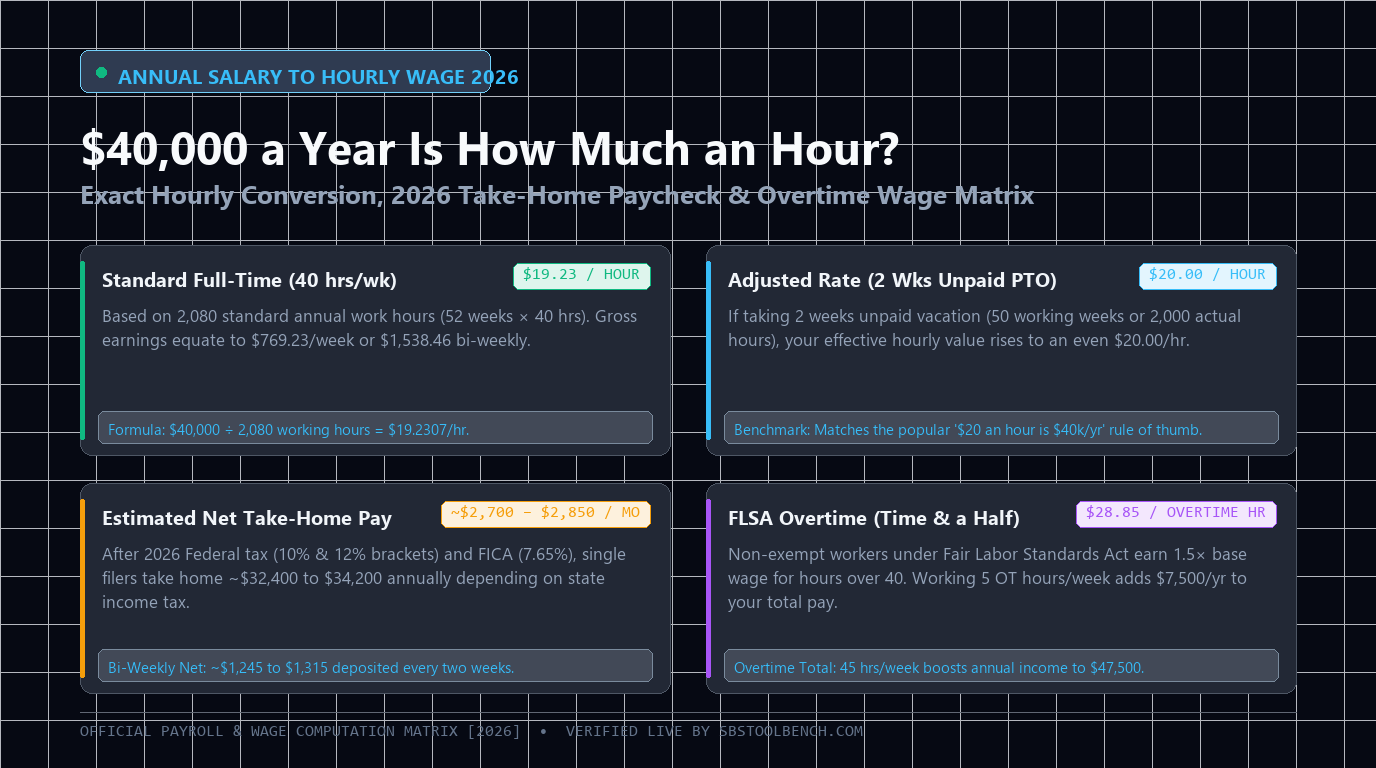
An annual salary of $40,000 breaks down to a gross wage of $19.23 per hour for a standard full-time schedule of 40 hours per week across 52 workweeks (2,080 working hours per year).
However, if your employer does not provide paid time off (PTO) and you take 2 weeks of unpaid vacation (50 working weeks or 2,000 hours per year), your effective hourly earnings equal exactly $20.00 per hour.
After mandatory federal withholdings (2026 standard deduction, 10% & 12% federal brackets) and FICA payroll taxes (6.2% Social Security + 1.45% Medicare), a single worker earning $40,000 takes home approximately $34,178 per year (or $2,848 per month) in states with zero income tax. In states with moderate income taxes, average net monthly take-home hovers around $2,700 to $2,790.
2. Comprehensive Second-by-Second to Annual Pay Breakdown
Whether evaluating a new job offer or planning monthly bills, understanding your exact rate across different payroll cycles is critical. The table below details $40,000 annual compensation across every standard payroll frequency, including estimated after-tax take-home for single filers residing in states without income tax.
| Pay Interval | Calculation Formula | Gross Earnings (Pre-Tax) | Net Take-Home (0% State Tax)* |
|---|---|---|---|
| Annual (Yearly) | Base salary | $40,000.00 | $34,178.50 |
| Monthly (12 Months) | $40,000 ÷ 12 | $3,333.33 | $2,848.21 |
| Semi-Monthly (24 Checks) | $40,000 ÷ 24 | $1,666.67 | $1,424.10 |
| Bi-Weekly (26 Checks) | $40,000 ÷ 26 | $1,538.46 | $1,314.56 |
| Weekly (52 Weeks) | $40,000 ÷ 52 | $769.23 | $657.28 |
| Daily (8-Hour Shift) | $769.23 ÷ 5 | $153.85 | $131.46 |
| Hourly (2,080 Hours) | $40,000 ÷ 2,080 | $19.23 | $16.43 |
| Working Minute | $19.23 ÷ 60 | $0.3205 | $0.2739 |
| Working Second | $0.3205 ÷ 60 | $0.0053 | $0.0046 |
3. Hours Worked Reality: 2,080 vs 2,000 vs 1,920 Hours
The mathematical baseline of 2,080 hours assumes an employee is compensated for every single hour across 52 weeks (40 hours × 52 weeks = 2,080 hours), including company-paid holidays, sick leave, and paid vacation days. For deep analysis on annual hour calculations, review our complete breakdown on How Many Working Hours in a Year? (2,080 Standard vs 2,000 Adjusted).
In real-world employment situations, benefits packages differ significantly. The comparison below illustrates how effective hourly compensation shifts based on actual working hours:
| Work Schedule Model | Annual Hours | Effective Hourly Rate | Scenario Context |
|---|---|---|---|
| Standard Full-Time (Paid PTO) | 2,080 hrs | $19.23 / hr | Full-time salaried or hourly with paid holidays and vacation. |
| Adjusted (2 Weeks Unpaid Leave) | 2,000 hrs | $20.00 / hr | 50 working weeks. Corresponds to our $20/hr guide. |
| Extended Leave (4 Weeks Unpaid) | 1,920 hrs | $20.83 / hr | Contract or seasonal positions taking 4 weeks unpaid time off. |
| Part-Time (30 Hours/Week) | 1,560 hrs | $25.64 / hr | 30 hrs/wk earning $40k total requires a $25.64 base wage. |
| Part-Time (20 Hours/Week) | 1,040 hrs | $38.46 / hr | Half-time schedule earning $40k requires $38.46/hr. |
4. 2026 Federal, FICA & State Take-Home Pay Models
Gross salary is what an employer advertises, but net take-home pay is what deposits into your checking account. For a single filer with no dependents taking the standard deduction, here is the exact 2026 federal tax architecture on a $40,000 salary:
2026 Federal & FICA Tax Breakdown ($40,000 Gross)
- Gross Income: $40,000.00
- Standard Deduction (Single Filer, 2026): $15,000.00
- Taxable Income: $25,000.00
- 10% Federal Bracket ($0 to $11,925): $1,192.50
- 12% Federal Bracket ($11,925 to $25,000): $1,569.00
- Total Federal Income Tax: $2,761.50 (Effective Federal Rate: ~6.90%)
- Social Security Tax (6.20% on $40,000): $2,480.00
- Medicare Tax (1.45% on $40,000): $580.00
- Total FICA Payroll Tax: $3,060.00 (7.65%)
- Total Federal + FICA Deductions: $5,821.50 (14.55% Total Federal Burden)
Because state tax rules vary dramatically across the country, where you reside has a measurable impact on your net paycheck. Below is a realistic take-home comparison across 10 major US states:
| State | Est. State Tax | Total Taxes Paid | Net Annual Pay | Net Monthly Pay | Effective Tax Rate |
|---|---|---|---|---|---|
| Texas (TX) | $0.00 | $5,821.50 | $34,178.50 | $2,848.21 | 14.55% |
| Florida (FL) | $0.00 | $5,821.50 | $34,178.50 | $2,848.21 | 14.55% |
| Washington (WA) | $0.00 | $5,821.50 | $34,178.50 | $2,848.21 | 14.55% |
| Ohio (OH) | ~$690.00 | $6,511.50 | $33,488.50 | $2,790.71 | 16.28% |
| California (CA) | ~$610.00 | $6,431.50 | $33,568.50 | $2,797.38 | 16.08% |
| Pennsylvania (PA) | ~$1,228.00 | $7,049.50 | $32,950.50 | $2,745.88 | 17.62% |
| North Carolina (NC) | ~$1,062.00 | $6,883.50 | $33,116.50 | $2,759.71 | 17.21% |
| Georgia (GA) | ~$1,200.00 | $7,021.50 | $32,978.50 | $2,748.21 | 17.55% |
| New York (NY) | ~$1,420.00 | $7,241.50 | $32,758.50 | $2,729.88 | 18.10% |
| Illinois (IL) | ~$1,844.00 | $7,665.50 | $32,334.50 | $2,694.54 | 19.16% |
5. Overtime & Multiplier Rates (FLSA Non-Exempt)
Under the Fair Labor Standards Act (FLSA), hourly and non-exempt employees earning $40,000 annually ($19.23/hr) must be paid at least 1.5× their regular hourly rate for any hours worked beyond 40 in a single workweek.
$19.23 / hr
Standard 1.0× multiplier$28.85 / hr
Overtime hours over 40$38.46 / hr
Holiday / 7th day premiumBecause the overtime rate jumps to $28.85 per hour, putting in just a few extra hours each week can increase your total gross income substantially:
| Weekly Overtime Hours | Weekly OT Earnings | Annual OT Bonus | New Total Annual Income |
|---|---|---|---|
| 2 Hours / Week (42 hrs total) | +$57.70 / wk | +$3,000.40 / yr | $43,000.40 |
| 5 Hours / Week (45 hrs total) | +$144.25 / wk | +$7,501.00 / yr | $47,501.00 |
| 10 Hours / Week (50 hrs total) | +$288.50 / wk | +$15,002.00 / yr | $55,002.00 |
| 15 Hours / Week (55 hrs total) | +$432.75 / wk | +$22,503.00 / yr | $62,503.00 |
6. 1099 Freelance & Contractor Equivalent ($28.50/hr)
If you are offered a 1099 contract position, accepting $19.23 per hour is a severe financial trap. Independent contractors must cover expenses that traditional W-2 employers normally pay:
Why 1099 Workers Need a 45%–55% Premium:
- Full Self-Employment Tax (15.3%): Employers pay 7.65% of FICA for W-2 staff. Contractors must pay both the employer and employee shares.
- Zero Paid Holidays & Sick Days: Taking 10 unpaid holidays and 2 weeks of vacation means billing only ~1,900 to 1,950 hours annually.
- Health Insurance & Retirement: No company 401(k) match or subsidized health, dental, or vision coverage.
- Operating Costs: Software licenses, hardware, internet, and bookkeeping.
To match the net economic value and take-home stability of a $40,000 W-2 salary, an independent contractor must charge between $28.50 and $31.00 per hour ($57,000 to $62,000 gross billing).
7. Living on $40k: 50/30/20 Budgeting & Housing Realities
Can you comfortably live on $40,000 a year? In moderate and low cost-of-living areas (MCOL/LCOL), $40k provides a manageable, balanced lifestyle for a single person who budgets intentionally. Applying the popular 50/30/20 rule to an average net monthly take-home of $2,800 yields the following framework:
$1,400 / mo
• Rent: $950–$1,050 (1-bd or shared)
• Groceries: $250
• Utilities & Phone: $100
$840 / mo
• Dining & Takeout: $250
• Entertainment & Streaming: $150
• Personal Shopping & Travel: $440
$560 / mo
• Emergency Fund: $300
• Roth IRA / 401(k): $160
• Student Debt / Credit: $100
Housing Affordability Benchmark: Financial advisors recommend spending no more than 30% of your gross monthly income on housing. For a $40,000 salary ($3,333/mo gross), the recommended rent limit is $1,000 per month. In expensive coastal cities (NYC, SF, Boston), living on $40k usually requires roommates or commuting from outer suburbs.
8. Wage Milestone Ladder: Career Progression Beyond $40k
A $40,000 income ($19.23/hr) represents an essential milestone bridging entry-level roles and established middle-income careers. Common roles paying around $40k include executive administrative assistants, customer success specialists, dental assistants, logistics dispatchers, and entry-level IT support technicians.
Review how your hourly wage and monthly take-home scale as you progress through higher salary brackets across the SBS ToolBench ecosystem:
| Annual Salary | Hourly Wage (2,080 hrs) | Monthly Gross | Detailed Conversion Guide |
|---|---|---|---|
| $30,000 / year | $14.42 / hr | $2,500.00 | $30k Wage & Take-Home Guide |
| $40,000 / year | $19.23 / hr | $3,333.33 | Current Guide |
| $50,000 / year | $24.04 / hr | $4,166.67 | $50k Wage & Take-Home Guide |
| $60,000 / year | $28.85 / hr | $5,000.00 | $60k Wage & Take-Home Guide |
| $80,000 / year | $38.46 / hr | $6,666.67 | $80k Wage & Take-Home Guide |
| $100,000 / year | $48.08 / hr | $8,333.33 | $100k Six-Figure Guide |
| $120,000 / year | $57.69 / hr | $10,000.00 | $120k Executive Pay Guide |
9. Frequently Asked Questions (FAQ)
What is $40,000 a year after taxes?
For a single filer claiming standard deductions, $40,000 after federal income tax ($2,761.50) and FICA payroll taxes ($3,060.00) equals approximately $34,178 per year (or $2,848/month) in no-tax states (Texas, Florida, Washington). In states with income tax, net take-home typically ranges between $32,300 and $33,500.
How much is $40k a year bi-weekly?
Dividing $40,000 across 26 bi-weekly pay periods equals $1,538.46 gross per paycheck. After federal tax and FICA withholdings, your estimated net bi-weekly paycheck is approximately $1,314.56 in zero-tax states, or roughly $1,245 to $1,290 in states with state income tax.
Is $40,000 a year a good salary?
$40,000 is considered a solid, liveable entry-to-mid career wage across most Midwestern, Southern, and rural areas of the United States. While below the US median household income (~$75,000), it provides comfortable financial footing for single adults who follow a structured 50/30/20 budget and maintain housing costs under $1,000/month.
Can I buy a house making $40,000 a year?
Yes, under favorable circumstances. Using standard 28/36 debt-to-income (DTI) mortgage qualifying guidelines, a $40k income allows for a maximum monthly mortgage payment of roughly $930. In affordable housing markets (home prices between $140,000 and $175,000), buyers utilizing FHA or USDA low-down-payment loans can realistically purchase a starter home.
What jobs pay $40,000 a year?
Common professions paying around $40k ($19 to $20/hr) include administrative assistants, customer care team leads, veterinary technicians, pharmacy technicians, junior graphic designers, entry-level web content editors, and logistics coordinators.