
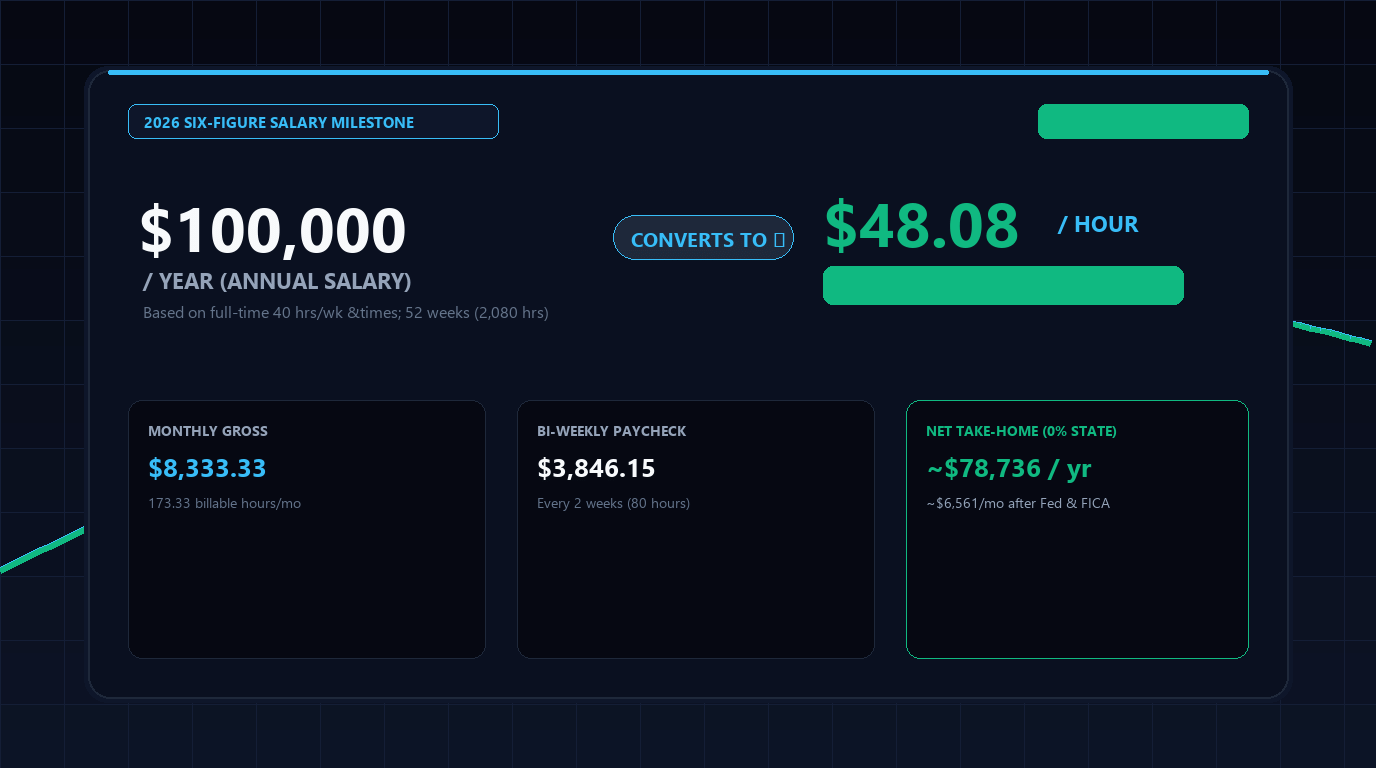
An annual salary of $100,000 per year converts to approximately $48.08 per hour based on a standard 40-hour workweek across 52 weeks (2,080 working hours). If your compensation package provides two weeks of paid time off (PTO) or you compute your earnings over 50 working weeks (2,000 actual hours worked), your rate equals an exact $50.00 per hour.
🧮 Calculating an Hourly Rate or Six-Figure Job Offer?
Evaluate personalized take-home pay with state tax deductions, 401(k) pre-tax contributions, and overtime multipliers using our live converter.
Launch Free Hourly to Salary Converter →Table of Contents (Click to Expand)
- 1. The Core Calculation: How $100,000 Converts to Hourly Pay
- 2. Paid Time Off (PTO) vs Unpaid Vacation: The $48.08 vs $50.00 Distinction
- 3. $100,000 Broken Down Across All Pay Frequencies
- 4. Hourly Equivalent on Alternative Work Schedules (30h, 35h, 45h, 50h)
- 5. Exact 2026 Taxes & Net Take-Home Pay ($100k After Taxes)
- 6. How to Live on $100,000 a Year: Realistic 50/30/20 Monthly Budget
- 7. Is $100k Still a Good Salary in 2026? US Purchasing Power & Inflation Reality
- 8. Exempt vs Non-Exempt Salaried Roles & Overtime Multipliers
- 9. Top Occupations & Careers That Pay $100,000+
- 10. Related Wage & Salary Benchmarks (The Salary Ladder)
- 11. Frequently Asked Questions (FAQ)
1. The Core Calculation: How $100,000 Converts to Hourly Pay
To convert a six-figure annual salary of $100,000 into an hourly rate, you divide the total gross earnings by the standard number of full-time working hours in a 52-week calendar year (40 hours per week × 52 weeks = 2,080 working hours):
This $48.08 base hourly rate represents your standard gross compensation before any mandatory or voluntary payroll withholdings, such as federal income taxes, FICA (Social Security and Medicare), state income taxes, employer health insurance, or pre-tax retirement accounts.
2. Paid Time Off (PTO) vs Unpaid Vacation: The $48.08 vs $50.00 Distinction
The effective value of your working hours shifts depending on your employment agreement and fringe benefits. Salaried employees with paid vacation receive compensation for all 2,080 hours. In contrast, 1099 independent contractors, locum tenens professionals, and hourly workers who take unpaid leave only generate income during billable hours:
If you take two weeks of unpaid time off, your billing rate must equal exactly $50.00 an hour across 2,000 working hours to reach an annual gross of $100,000.
3. $100,000 Broken Down Across All Pay Frequencies
Here is how a $100,000 annual compensation package distributes across each primary US payroll payment cycle:
4. Hourly Equivalent on Alternative Work Schedules (30h, 35h, 45h, 50h)
If your specific role requires more or fewer than 40 hours per week, your actual hourly rate changes accordingly:
5. Exact 2026 Taxes & Net Take-Home Pay ($100k After Taxes)
Below is the exact 2026 federal and FICA payroll tax withholding schedule for an unmarried individual taking the IRS standard deduction ($15,000 for single filers in 2026):
Federal & FICA Deductions Breakdown (2026 IRS Rules)
- Gross Annual Salary: $100,000.00
- 2026 Single Standard Deduction: -$15,000.00
- Federal Taxable Income: $85,000.00
- Federal Income Tax (10%, 12%, 22% brackets): -$13,614.00 (Effective rate ~13.61%)
- FICA – Social Security (6.2% on first $176,100): -$6,200.00
- FICA – Medicare (1.45% on all earnings): -$1,450.00
- Total Mandatory Federal Withholding: -$21,264.00 (21.26% of gross)
State tax obligations heavily alter take-home pay based on your geographic location:
6. How to Live on $100,000 a Year: Realistic 50/30/20 Monthly Budget
In a zero income tax state with approximately $6,561 per month in net take-home pay, following the classic 50/30/20 budget framework enables strong capital accumulation and discretionary freedom:
50% Needs: $3,281 / month
- Rent / Mortgage: $1,850 – $2,200
- Utilities & High-Speed Internet: $270
- Groceries & Household Goods: $550
- Car Payment, Gas & Insurance: $461
30% Wants: $1,968 / month
- Dining Out & Social Events: $600
- Travel & Flights: $500
- Subscriptions & Memberships: $120
- Shopping & Apparel: $350
- Entertainment & Hobbies: $398
20% Savings & Debt: $1,312 / month
- Roth IRA: $583 (Max $7,000/yr limit)
- Employer 401(k) / HSA: $450
- High-Yield Emergency Fund: $279
- Annual Wealth Accumulation: $15,744 / year
7. Is $100k Still a Good Salary in 2026? US Purchasing Power & Inflation Reality
Yes. Earning $100,000 annually as an individual places you in the top 20% to 22% of individual income earners in the United States. It substantially surpasses the US median household income ($74,580), achieving as a single earner what typically requires multiple incomes.
Purchasing power is largely determined by housing costs:
- Low/Moderate Cost of Living (LCOL/MCOL): In cities like Dallas, Atlanta, Phoenix, Indianapolis, or Columbus, $100,000 provides an affluent upper-middle-class standard of living with easy mortgage qualification for properties in the $350,000 to $450,000 price band.
- High Cost of Living (HCOL): In competitive coastal hubs like New York City, San Francisco, Boston, or Seattle, $100,000 allows for a comfortable single lifestyle, but purchasing real estate typically requires dual incomes.
8. Exempt vs Non-Exempt Salaried Roles & Overtime Multipliers
Under the Fair Labor Standards Act (FLSA), positions paying $100,000 generally meet the salary basis and job duties tests for exempt professional or executive status, meaning overtime pay is not required. However, for non-exempt hourly employees working at an equivalent $48.08/hr base rate, mandatory 1.5× time-and-a-half equals $72.12 per hour.
9. Top Occupations & Careers That Pay $100,000+
Key professions and career paths that regularly offer six-figure base salaries include:
- Senior Software Engineers & Full-Stack Developers: $95,000 – $130,000
- Nurse Practitioners & Traveling Registered Nurses: $95,000 – $125,000
- Construction Project Managers & Superintendents: $90,000 – $115,000
- Corporate Financial Controllers & Senior Analysts: $95,000 – $120,000
- Product Managers & UX Directors: $100,000 – $135,000
- Cloud Solutions Architects & Cybersecurity Engineers: $105,000 – $140,000
10. Related Wage & Salary Benchmarks (The Salary Ladder)
Compare how $100,000 per year benchmarks against other key compensation tiers in our workforce calculator library:
11. Frequently Asked Questions (FAQ)
How much is $100,000 a year per hour?
Assuming a standard 40-hour workweek for 52 weeks (2,080 hours), $100,000 equals exactly $48.08 per hour. If evaluated over 50 working weeks with two weeks of unpaid vacation (2,000 hours), it equals exactly $50.00 per hour.
What is $100k a year after taxes?
In 2026, a single filer paying federal income tax ($13,614) and FICA taxes ($7,650) takes home approximately $78,736 per year (~$6,561/month) in states with no income tax (TX, FL, WA). In moderate tax states, net pay is ~$74,236, and in high-tax states like CA or NY, net pay is roughly $71,236.
How much is $100,000 a year bi-weekly?
Across 26 annual pay periods, your gross bi-weekly paycheck is $3,846.15. After mandatory 2026 federal and FICA payroll taxes, net take-home is roughly $3,028.31 bi-weekly in a no-tax state.
What is $100k a year broken down monthly?
Before taxes, $100,000 equals exactly $8,333.33 per month ($100,000 divided by 12 months). After standard federal and FICA taxes, net monthly take-home pay is approximately $6,561.33 in a no-tax state.
Can you buy a house on $100k a year?
Yes. Under conventional banking guidelines following the 28% front-end debt-to-income rule, a $100,000 salary allows up to $2,333 in monthly housing payments, qualifying you for a mortgage between $350,000 and $450,000 with a good credit score and modest down payment.