
📑 Quick Navigation: Table of Contents
1. Quick Answer: What Percentage is a First-Class Degree in the UK?
2. UK Undergraduate Degree Classification Hierarchy Table
3. Why 70% in the UK Is NOT a ‘C’ (The British Marking Philosophy)
4. How UK Universities Calculate a First: Year-Weighting Formulas
5. The Borderline Discretion Rule: What Happens at 68% or 69%?
6. International Equivalency Matrix (US GPA, Canadian OMSAS & ECTS)
7. Official HESA Statistics: How Common Is a First-Class Degree?
8. Career & Postgraduate Impact: Magic Circle, Banking & PhD Funding
1. Quick Answer: What Percentage is a First-Class Degree in the UK?
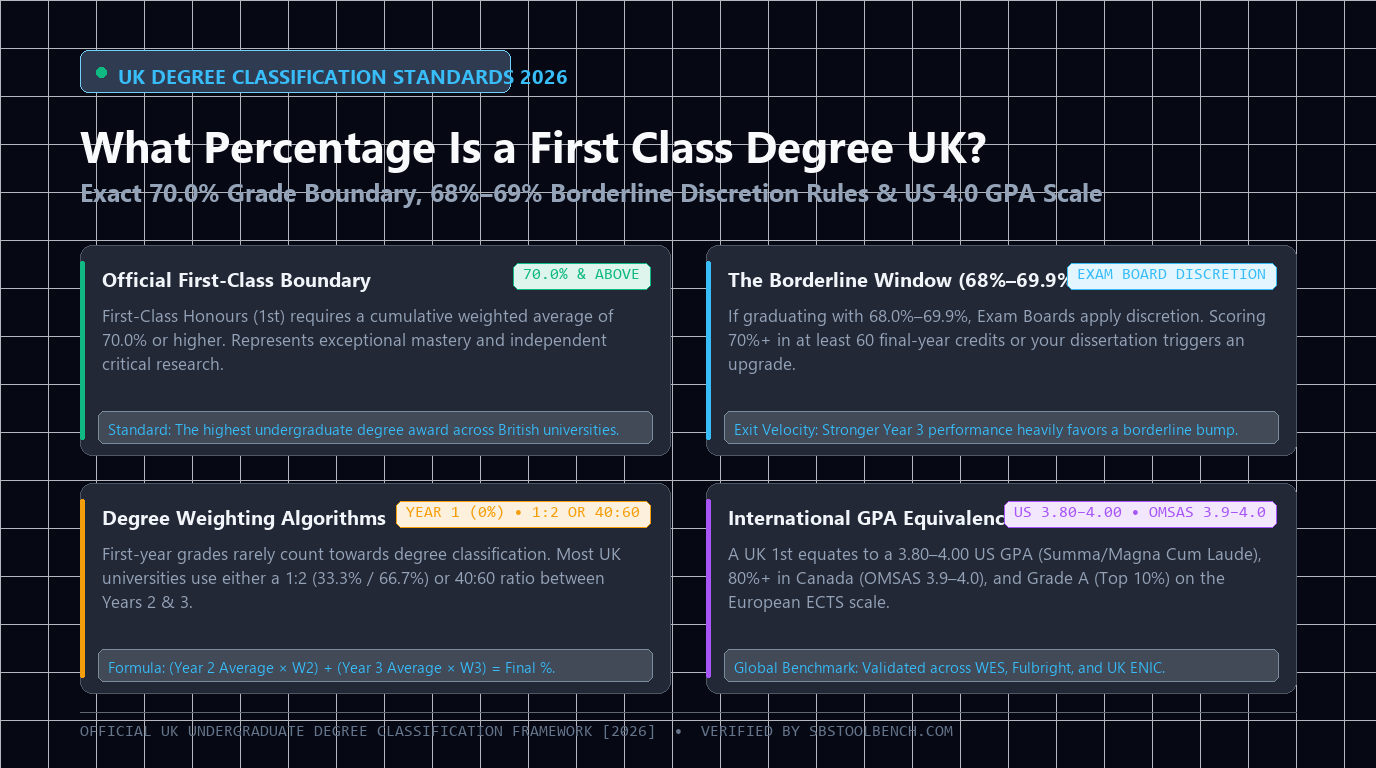
In the United Kingdom higher education system, a First-Class Honours degree (commonly referred to as a “First” or “1st”) requires an overall weighted academic average of 70.0% or higher. It is the highest undergraduate academic classification awarded by British universities.
If your overall final score finishes in the 68.0% to 69.9% borderline window, you are not automatically locked out of a First. Most UK university examination boards (including Oxford, Cambridge, Russell Group, and London universities) enforce formal borderline discretion algorithms. If you achieved 70%+ in at least half of your final-year credits or scored a First on your dissertation, your degree classification is typically elevated to a First Class Honours.
2. UK Undergraduate Degree Classification Hierarchy Table
Unlike North American universities that calculate cumulative GPA on a 4.0 scale, British universities classify honours degrees into five standard tiers based on overall percentage marks. The table below outlines the formal classification bands, colloquial terminology, and international letter grade benchmarks:
| Degree Classification | Common Abbreviation | Percentage Boundary | US GPA Equivalent | Academic Standing Description |
|---|---|---|---|---|
| First-Class Honours | 1st / First | 70.0% – 100% | 3.80 – 4.00 | Highest academic achievement; exceptional scholarship and analytical rigor. |
| Upper Second-Class Honours | 2:1 (“Two-One”) | 60.0% – 69.9% | 3.30 – 3.69 | Strong, thorough understanding; minimum threshold for UK top graduate schemes. |
| Lower Second-Class Honours (2:2) | 2:2 (“Two-Two”) | 50.0% – 59.9% | 2.70 – 3.29 | Sound comprehension with some analytical limitations or inconsistency. |
| Third-Class Honours | 3rd / Third | 40.0% – 49.9% | 2.00 – 2.69 | Basic pass fulfilling minimum module learning outcomes without distinction. |
| Fail (Non-Honours) | Fail / Ordinary | Below 40.0% | 0.00 – 1.99 | Insufficient credits or marks to earn an accredited Bachelor’s honours award. |
3. Why 70% in the UK Is NOT a ‘C’ (The British Marking Philosophy)
International students from the United States, Canada, India, or Pakistan are often terrified when they receive a 68% or 72% on an undergraduate essay, assuming it corresponds to a mediocre ‘C’ grade. In the British university grading philosophy, the marking scale operates on fundamentally different standards:
The British University Grade Scale Unpacked:
- 80% and Above (High First / Exceptional): Reserved for work that is of publishable standard or demonstrates outstanding, flawless scholarly original thinking. Fewer than 3% of all undergraduate assignments in humanities and social sciences receive an 80%+.
- 70% – 79% (First Class): Work that demonstrates deep critical engagement, independent reading outside the syllabus, excellent structure, and flawless academic referencing. This is the UK equivalent of an American ‘A’ or 4.0 GPA.
- 60% – 69% (2:1 Upper Second): Very good, solid academic work with strong analytical capability and minor gaps in originality. Corresponds to an American ‘B+’ / ‘A-‘.
- 50% – 59% (2:2 Lower Second): Adequate descriptive answers meeting standard module requirements, but lacking critical synthesis. Corresponds to an American ‘B’ / ‘B-‘.
4. How UK Universities Calculate a First: Year-Weighting Formulas
A major relief for UK university undergraduates is that First Year (Level 4) almost never counts towards your degree classification. First-year modules serve as a developmental baseline: as long as you pass the required 120 credits (scoring 40%+), your Year 1 marks have 0% weighting in your final degree classification.
For standard 3-year BA/BSc degrees, UK institutions calculate your final degree percentage using one of two predominant weighting ratios:
| Weighting Model | Year 1 Weight | Year 2 (Level 5) Weight | Year 3 (Level 6) Weight | Example Universities Using Model |
|---|---|---|---|---|
| The 1:2 Ratio (33.3% / 66.7%) | 0% | 33.33% (1/3) | 66.67% (2/3) | UCL, King’s College London, Warwick, Queen Mary |
| The 40:60 Ratio | 0% | 40.0% | 60.0% | Manchester, Bristol, Nottingham, Birmingham, Leeds |
| The 50:50 Ratio (4-Year Scottish MA) | 0% (Y1 & Y2) | 50.0% (Junior Hons) | 50.0% (Senior Hons) | Edinburgh, St Andrews, Glasgow, Aberdeen |
Worked Example: If you achieved a 64.0% average in Year 2 and pushed your performance up to a 73.0% average in Year 3 under the 1:2 ratio:
Final Mark = (64.0 × 0.3333) + (73.0 × 0.6667) = 21.33 + 48.67 = 70.0% → Awarded a First-Class Honours Degree!
5. The Borderline Discretion Rule: What Happens at 68% or 69%?
Finishing with an overall degree average between 68.0% and 69.9% places you inside the university’s official Borderline Discretion Zone (sometimes called the “Zone of Consideration”). Exam Boards do not flip a coin; they execute established academic criteria to determine whether to round you up to a First:
The 3 Key Tests Exam Boards Apply at 68%–69%:
- The Predominant Quality / Credit Profile Rule: At least 60 credits (out of 120 total credits in your final year) must be marked at 70% or higher.
- The Dissertation / Capstone Project Rule: Your final-year dissertation, independent research thesis, or major design project must be graded in the First-Class band (70%+).
- Exit Velocity (Upward Trajectory): Your Year 3 average must clearly exceed your Year 2 marks, proving that your academic standard accelerated into graduation.
6. International Equivalency Matrix (US GPA, Canadian OMSAS & ECTS)
When applying to prestigious postgraduate programs across North America and Europe, credential evaluators (such as WES, Fulbright, and UK ENIC) standardize British marks into local GPA systems. The comparative conversion matrix below illustrates official equivalents:
| UK Degree Classification | UK Percentage | US 4.0 GPA | Canadian OMSAS 4.0 | European ECTS Grade |
|---|---|---|---|---|
| First-Class Honours (High) | 75% – 100% | 4.00 (Summa Cum Laude) | 4.00 (90%+ scale) | Grade A (Top 10%) |
| First-Class Honours (Standard) | 70% – 74.9% | 3.80 – 3.90 (Magna) | 3.90 (85%–89%) | Grade A (Top 10%) |
| Upper Second-Class (2:1) | 60% – 69.9% | 3.30 – 3.69 (Cum Laude) | 3.00 – 3.30 (73%–79%) | Grade B (Next 25%) |
| Lower Second-Class (2:2) | 50% – 59.9% | 2.70 – 3.29 | 2.00 – 2.70 (63%–72%) | Grade C (Next 30%) |
| Third-Class Honours (3rd) | 40% – 49.9% | 2.00 – 2.69 | 0.70 – 1.70 (50%–62%) | Grade D / E |
Applying to Canadian medical schools or graduate institutions? Examine our complete guide on Canada Percentage to GPA Conversion Guide: OMSAS 4.0 & 4.33 Scales for provincial benchmarks across Ontario, UBC, McGill, and Alberta.
7. Official HESA Statistics: How Common Is a First-Class Degree?
According to official data published by the Higher Education Statistics Agency (HESA) and the UK Office for Students (OfS), approximately 30% to 32% of all UK university graduates achieve a First-Class Honours degree.
While degree distributions increased during pandemic safety-net policies, regulatory bodies have stabilized standards: around 80% of students achieve an “Upper Degree” (either a 1st or a 2:1), with the First Class award remaining the gold standard credential for elite graduate programs and competitive industry recruitment.
8. Career & Postgraduate Impact: Magic Circle, Banking & PhD Funding
While a 2:1 degree qualifies you for over 85% of corporate graduate schemes in the UK, earning a First-Class Honours unlocks several exclusive career avenues:
Key Advantages of Graduating with a First:
- Fully-Funded UKRI PhD Studentships: Research councils (EPSRC, ESRC, AHRC, MRC) heavily favor candidates with First-Class Honours when awarding competitive tuition and maintenance grants.
- Elite Strategy Consulting & Magic Circle Law: Firms like McKinsey, BCG, Clifford Chance, and Slaughter & May receive thousands of 2:1 applications; a First Class degree serves as an instant competitive differentiator.
- Ivy League & Oxbridge Master’s Entry: University of Oxford, Cambridge, Harvard, and Stanford Master’s admissions boards typically require a UK First (or minimum high 2:1 with 67%+) for competitive consideration.
9. Frequently Asked Questions (FAQ)
What percentage is a first class degree in the UK?
A First-Class Honours degree requires an overall weighted academic average of 70.0% or higher across your degree-qualifying years (typically Years 2 and 3).
Can you get a First with 68% or 69%?
Yes. Most UK universities operate a borderline discretion rule for students finishing between 68.0% and 69.9%. You are typically upgraded to a First if you earned 70%+ in at least half of your final-year credits or scored 70%+ on your dissertation.
What is a UK First Class degree equivalent to in US GPA?
A UK First Class Honours is officially recognized as equivalent to a 3.80 to 4.00 US GPA (Summa Cum Laude or Magna Cum Laude), reflecting an ‘A’ grade average.
Does Year 1 count towards a First Class degree?
No. At virtually all UK universities, first-year marks carry a 0% weighting toward your degree classification. You simply need to achieve a passing grade (40%+) to progress into Year 2.
Is a 2:1 a good degree compared to a First?
Yes. An Upper Second-Class (2:1, 60%–69.9%) is considered a very strong academic result and satisfies the eligibility criteria for the vast majority of graduate training schemes and Master’s admissions worldwide. A First represents the pinnacle of undergraduate performance.