
📑 Quick Navigation: Table of Contents
1. Quick Answer: What Percentage is a 2:2 Degree in the UK?
2. UK Undergraduate Degree Classification Hierarchy Table
3. Why 50% in the UK Is NOT an ‘F’ (The British Marking Scale)
4. The 58%–59% Borderline Discretion Rule: Upgrading to a 2:1
5. How UK Universities Calculate a 2:2: Year-Weighting Formulas
6. International Equivalency Matrix (US GPA, Canadian OMSAS & ECTS)
7. Official HESA Statistics: How Common Is a 2:2 Degree?
8. Career & Master’s Realities: Employers Dropping the 2:1 Filter
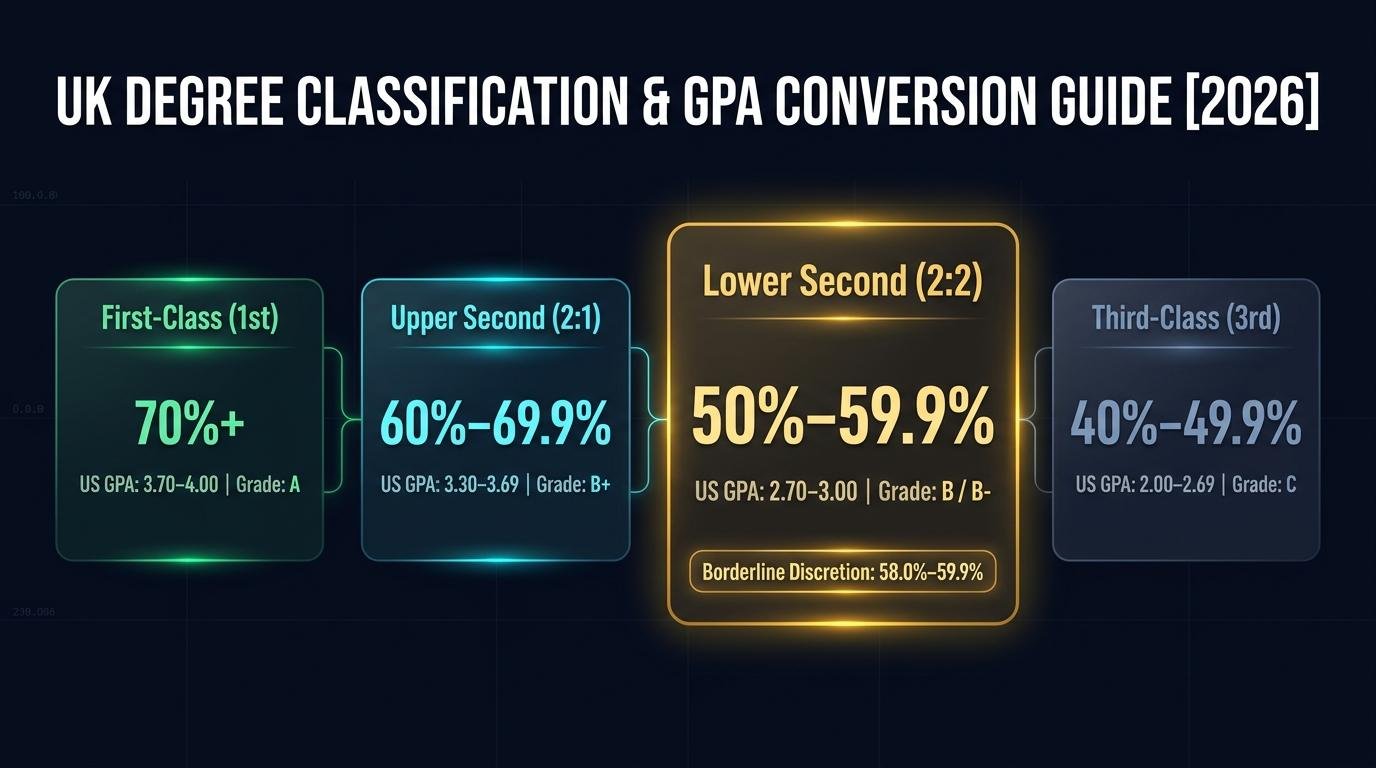
In the UK university grading framework, a 2:2 degree (Lower Second-Class Honours) requires a final weighted average between 50.0% and 59.9%. Internationally, this equates to a US GPA of 2.70 to 3.00 (Grade B/B-), an ECTS Grade C, and qualifies for numerous Russell Group Master’s courses and top graduate employers that have removed the 2:1 application barrier.
⚡ Quick Answer: What Percentage Is a 2:2 Degree in the UK?
A 2:2 degree (Lower Second-Class Honours), affectionately nicknamed a “Desmond” in British student culture, requires an overall degree percentage between 50.0% and 59.9%. Unlike the American system where 50% indicates academic failure, in the UK a 50% is a solid, rigorous passing grade reflecting sound understanding of degree-level syllabus material.
2. UK Undergraduate Degree Classification Hierarchy Table
Under the British undergraduate honours system (BA, BSc, BEng, LLB), degrees are not awarded as simple GPA scores. Instead, universities group performance into established Latin-derived classification tiers standardized by the Quality Assurance Agency (QAA):
| Degree Classification | Colloquial Term | Percentage Boundary | US GPA Band | Academic Status |
|---|---|---|---|---|
| First-Class Honours | 1st / “First” | 70.0% – 100% | 3.70 – 4.00 (A) | Elite academic distinction; funded PhDs |
| Upper Second-Class Honours | 2:1 / “Two-One” | 60.0% – 69.9% | 3.30 – 3.67 (B+) | Corporate benchmark; standard Russell Group MSc entry |
| Lower Second-Class Honours | 2:2 / “Desmond” | 50.0% – 59.9% | 2.70 – 3.00 (B/B-) | Honours degree; accepted by expanding employer pool |
| Third-Class Honours | 3rd / “Third” | 40.0% – 49.9% | 2.00 – 2.30 (C) | Lowest honours level; limited postgraduate eligibility |
| Ordinary Degree (Pass) | Non-Honours Pass | 35.0% – 39.9% | 1.00 – 1.50 (D) | Degree without Honours |
| Fail | Fail | Below 40.0% | 0.00 (F) | No qualification awarded |
3. Why 50% in the UK Is NOT an ‘F’ (The British Marking Scale)
International students—particularly from the United States, Canada, and India—are frequently shocked when they receive marks in the 50s. In the US high school and university system, a score of 55% represents failing coursework (Grade F). In the UK university system, this comparison is entirely false.
British universities utilize a criterion-referenced criterion scale rather than a percentage accumulation model:
- The 80%+ Ceiling: In arts, humanities, and social sciences, UK professors almost never award marks above 78% unless the research is literally of publishable peer-reviewed standard. A 70% is already considered exceptional academic excellence.
- The 50%–59% Competency Band: Achieving a mark between 50% and 59% demonstrates that the student has fulfilled all essential learning outcomes, understood primary theoretical models, conducted coherent analysis, and backed arguments with proper citations.
- Honours Standing: A 2:2 is legally an Honours degree. In the UK, graduating with honours signifies rigorous, specialized academic study beyond an ordinary general diploma.
4. The 58.0%–59.9% Borderline Discretion Rule: Upgrading to a 2:1
What happens if your final weighted degree average lands at 58.4% or 59.2%? Every accredited UK university operates an official Examination Board Borderline Policy (commonly known as the 2% discretionary window).
How Exam Boards Decide to Upgrade a 2:2 to a 2:1:
- Credit Profiling (The 50% Rule): Most institutions (including Manchester, Leeds, and Bristol) require that at least 50% of your final-year credits (60 out of 120 credits) sit within the higher 2:1 class (60.0%+). If your average is 58.8% but 4 out of your 6 modules scored above 60%, you are almost always upgraded.
- Dissertation / Capstone Weighting: Many exam boards mandate that your independent final-year research project or dissertation must achieve a mark of 60% or higher to validate the upgrade.
- Exit Velocity (Upward Trajectory): If your marks in Year 2 were in the low 50s but your Year 3 modules surged into the mid-60s, exam committees recognize academic momentum.
- Extenuating Circumstances: If you experienced documented health or personal hardships that impacted specific exam papers, boards apply discretionary rounding.
5. How UK Universities Calculate a 2:2: Year-Weighting Formulas
A critical misconception among first-year students is assuming Year 1 counts toward their final honours classification. Across almost all UK three-year bachelor’s programs:
- Year 1 (Certificate Level): Contributes 0% toward degree classification. Students must merely achieve 40% to pass and progress.
- Standard 1:2 Weighting (33.3% Year 2 / 66.7% Year 3): The dominant model across Russell Group and pre-1992 institutions. Year 3 carries double the mathematical power of Year 2.
- 40:60 Ratio: Common across technical and polytechnic universities.
Mathematical Case Study: Pulling a 2:2 into a 2:1
Suppose James scores 52.0% in Year 2. In Year 3, James works diligently and scores 64.0%. Under a standard 1:2 weighting formula:
Even with a lower 2:2 performance in Year 2, the heavy double-weighting of Year 3 pulls James across the 60.0% threshold into an Upper Second-Class degree. Use our interactive UK Degree Classification Calculator to test your own module breakdown.
6. International Equivalency Matrix (US GPA, Canadian OMSAS & ECTS)
When applying to graduate schools in North America or multinational employment registries, credential evaluation bodies like WES (World Education Services) and ECE convert British degree classifications using established equivalency tables:
| Country / System | Evaluation Standard | UK 2:2 Equivalent | Evaluation Notes |
|---|---|---|---|
| United States | WES 4.0 GPA Scale | 2.70 – 3.00 GPA (Grade B/B-) | WES scales 50–54% as 2.7 and 55–59% as 3.0 |
| Canada (Ontario) | OMSAS 4.0 Scale | 2.70 / 4.00 (70% OMSAS band) | See our complete Canada Percentage to GPA Guide |
| European Union | ECTS Grading Framework | Grade C (“Good”) | Represents top 25% to 50% percentile cohort |
| Australia | 7.0 GPA / Percentage Scale | Credit (65% – 74% Aus) | Australian universities curve higher than UK scales |
7. Official HESA Statistics: How Common Is a 2:2 Degree?
According to official higher education data from the Higher Education Statistics Agency (HESA), degree classification distributions across all UK providers reflect the following trends:
- First-Class Honours (70%+): Approximately 32% to 35% of students.
- Upper Second-Class (2:1 / 60–69%): Approximately 46% to 48% of students.
- Lower Second-Class (2:2 / 50–59%): Approximately 18% to 22% of students.
- Third-Class (40–49%): Approximately 3% to 4% of graduates.
In rigorous STEM degrees (Engineering, Physics, Mathematics, and Computer Science), the proportion of 2:2 degrees is higher than in Humanities, as technical examinations feature absolute objective problem sets with zero grade inflation.
8. Career & Master’s Realities: Employers Dropping the 2:1 Filter
For decades, corporate graduate schemes enforced a strict automated filter discarding any applicant with a 2:2. In 2026, this landscape has changed dramatically:
Big 4 & Financial Services
PwC, EY, and Deloitte have eliminated the strict 2:1 degree requirement for graduate intake schemes to increase socioeconomic diversity. Candidates are now evaluated primarily on online psychometric reasoning and assessment center performance.
Public Sector & Healthcare
The Civil Service Fast Stream, NHS Graduate Management Training Scheme, Police Now, and Teach First welcome applications from candidates with a 2:2 degree, focusing on core leadership competencies.
Russell Group Master’s Entry
Many top universities (including Warwick, Nottingham, Queen Mary, and Liverpool) accept 2:2 applicants for taught Master’s programs when accompanied by strong academic references, industry experience, or a pre-Master’s conversion certificate.
Explore the Complete UK Degree Classification Hub:
9. Frequently Asked Questions (FAQ)
What percentage is a 2:2 degree in the UK?
A 2:2 degree (Lower Second-Class Honours) requires an overall final weighted mark between 50.0% and 59.9%.
What is a UK 2:2 degree equivalent to in US GPA?
Under major credential evaluators like WES (World Education Services), a UK 2:2 degree is equivalent to a US GPA of 2.70 to 3.00 (equivalent to a solid Grade B/B-).
Can a 58% or 59% be rounded up to a 2:1?
Yes. Most UK universities operate a 2% borderline consideration window. If your final weighted average is between 58.0% and 59.9% and you earned at least half of your final-year credits (or your dissertation) in the 60%+ band, exam boards typically upgrade your degree to an Upper Second-Class (2:1).
Can I get a Master’s degree with a 2:2?
Yes. Many accredited UK universities accept applicants with a 2:2 for taught Master’s programs, especially when supported by professional work experience, a strong personal statement, or performance in relevant final-year modules.
Why is a 2:2 called a ‘Desmond’?
In British student slang, a 2:2 is universally called a “Desmond” in rhyming reference to the Nobel Peace Prize laureate Archbishop Desmond Tutu (Two-Two).