
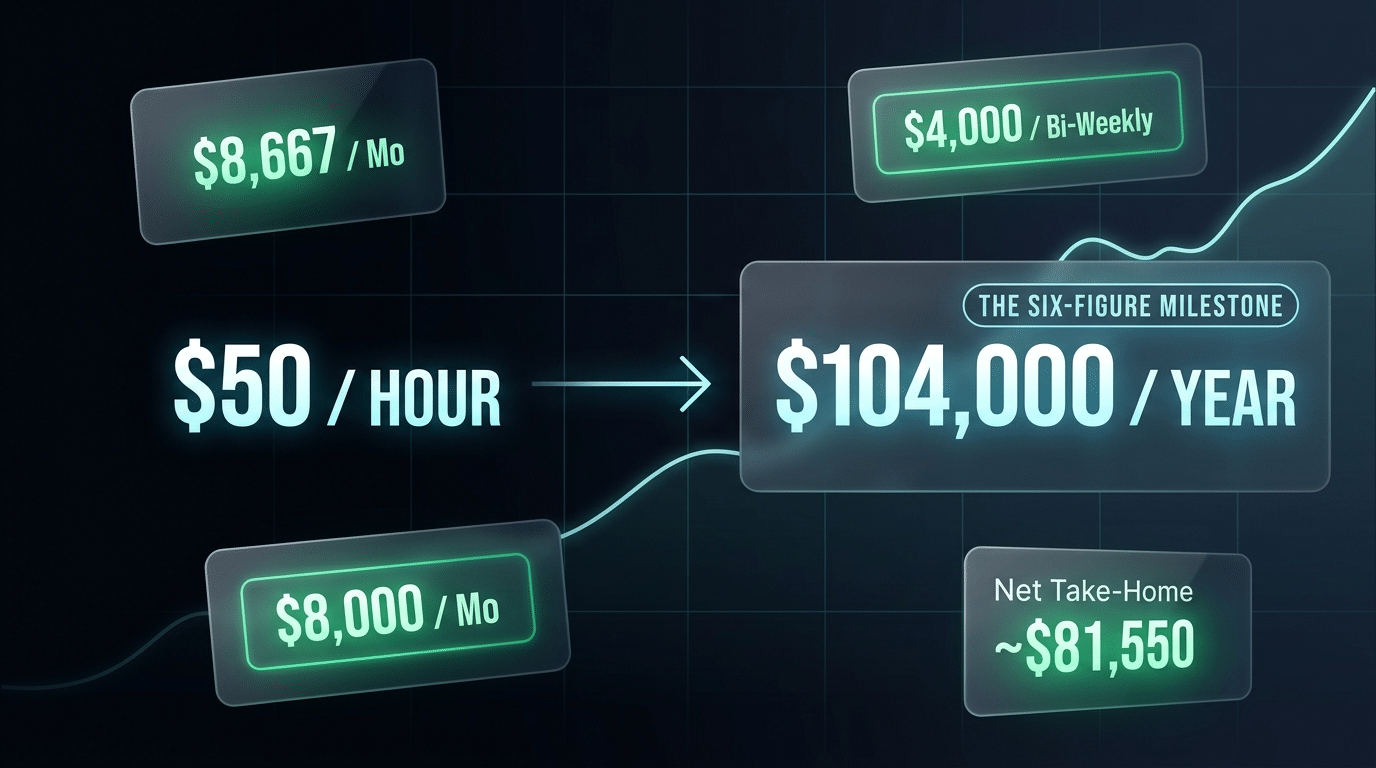
If you earn $50.00 per hour and work a standard full-time schedule of 40 hours per week, your annual gross salary is $104,000 per year before taxes and payroll deductions. Hitting the $50 an hour mark is one of the most celebrated financial milestones in the American workforce, officially crossing the psychological and financial threshold into six-figure income status.
🧮 Need Custom Overtime, Vacation Days, or Local State Tax Calculations?
Plug your specific hourly rate, unworked holidays, 401(k) pre-tax contributions, and state residency directly into our live interactive calculator for instant real-time results.
Launch Free Hourly to Salary Converter →Table of Contents (Click to Expand)
- 1. The Core Calculation: How $50/Hour Becomes $104,000/Year
- 2. Paid Time Off vs Unpaid Vacation: The 2,080 vs 2,000 Hours Difference
- 3. $50 an Hour Converted Across All Paycheck Frequencies
- 4. Part-Time Schedules: 20, 25, 30, and 35 Hours per Week
- 5. Exact 2026 Taxes & Net Take-Home Pay ($50/Hr After Taxes)
- 6. How to Live on $50 an Hour: Realistic 50/30/20 Budget Breakdown
- 7. Is $50 an Hour Good Pay in 2026? Geographic Purchasing Power
- 8. Overtime Calculations ($75/Hour FLSA Time-and-a-Half)
- 9. Hourly Wage Comparison Context (The Salary Ladder)
- 10. Frequently Asked Questions (FAQ)
1. The Core Calculation: How $50/Hour Becomes $104,000/Year
In payroll accounting and human resources, a standard full-time working year consists of 52 weeks. If an employee works 40 hours per week, the total annual working hours equal:
2,080 hours × $50.00/hour = $104,000.00 Gross Annual Income
This formula represents your gross earnings—the total compensation agreed upon with your employer before mandatory payroll withholdings, including federal income taxes, FICA (Social Security and Medicare), state income taxes, local taxes, health insurance premiums, or pre-tax retirement accounts such as a 401(k) or HSA.
2. Paid Time Off vs Unpaid Vacation: The 2,080 vs 2,000 Hours Difference
Whether you actually take home $104,000 depends heavily on your company’s fringe benefit package. If you are an exempt salaried employee or a W-2 hourly worker with Paid Time Off (PTO) and paid federal holidays, your employer pays you for all 52 weeks (2,080 hours) regardless of vacations taken.
However, if you work as a 1099 independent contractor, freelance consultant, or an hourly employee without paid vacation, taking time off directly deducts from your annual gross earnings:
3. $50 an Hour Converted Across All Paycheck Frequencies
Employers distribute payroll across various payment cycles. Understanding your exact paycheck amount before taxes allows you to streamline automated transfers, bills, and monthly loan payments:
4. Part-Time Schedules: 20, 25, 30, and 35 Hours per Week
Due to the lucrative $50/hour rate, many professionals—such as traveling registered nurses, software contractors, specialized paralegals, and creative directors—choose reduced workweeks to achieve superior work-life balance while still out-earning the median American full-time worker:
5. Exact 2026 Taxes & Net Take-Home Pay ($50/Hr After Taxes)
While your gross pay is $104,000 per year, your net take-home pay is what actually lands in your bank account. Below is the exact 2026 tax breakdown for a single filer claiming the $15,000 IRS standard deduction:
Federal & FICA Deductions Breakdown (2026 IRS Rules)
- Gross Annual Income: $104,000.00
- 2026 Single Standard Deduction: -$15,000.00
- Federal Taxable Income: $89,000.00
- Federal Income Tax (Marginal 10%, 12%, 22% brackets): -$14,494.00 (Effective rate ~13.94%)
- FICA – Social Security (6.2% on first $176,100): -$6,448.00
- FICA – Medicare (1.45% on all earnings): -$1,508.00
- Total Mandatory Federal Withholding: -$22,450.00 (21.59% of gross)
Because state income taxes vary from 0% to over 9%, your state of residency dramatically influences your monthly disposable income:
6. How to Live on $50 an Hour: Realistic 50/30/20 Budget Breakdown
At $50/hour, you have significant financial flexibility. In a tax-friendly state with approximately $6,796 in monthly net take-home pay, following Senator Elizabeth Warren’s classic 50/30/20 budget framework provides an exceptionally stable wealth-building roadmap:
50% Needs: $3,398 / month
- Rent / Mortgage: $1,900 – $2,300
- Utilities & Internet: $280
- Groceries: $550
- Auto / Transit / Gas: $450
- Health & Auto Insurance: $218
30% Wants: $2,039 / month
- Dining Out & Bars: $600
- Travel & Weekend Getaways: $500
- Subscriptions & Memberships: $120
- Shopping & Apparel: $350
- Hobbies & Entertainment: $469
20% Savings & Debt: $1,359 / month
- Roth IRA / Brokerage: $583 (Max $7k/yr)
- Employer 401(k) Match: $450
- Emergency High-Yield Savings: $326
- Annual Wealth Accumulation: $16,308 / year
7. Is $50 an Hour Good Pay in 2026? Geographic Purchasing Power
Yes, $50 an hour is widely considered very good pay across the United States. According to recent Bureau of Labor Statistics (BLS) and US Census Bureau wage data, an individual earning $104,000 ranks in the top 20% of individual income earners nationwide, substantially surpassing the median individual income of approximately $48,000.
However, purchasing power is dictated by local housing markets:
- Low to Moderate Cost of Living (LCOL/MCOL): In cities like Indianapolis, Columbus, San Antonio, Kansas City, or Tampa, $104,000 offers an affluent, upper-middle-class lifestyle. You can easily purchase a spacious single-family home, contribute aggressively to retirement funds, take multiple vacations, and save substantial capital.
- High Cost of Living (HCOL): In competitive metropolitan areas like New York City, San Francisco, Los Angeles, Boston, or Seattle, $104,000 provides a secure, comfortable single lifestyle. You can afford a private 1-bedroom apartment and discretionary spending, but purchasing single-family real estate will require disciplined dual-income budgeting or substantial down payment savings.
8. Overtime Calculations ($75/Hour FLSA Time-and-a-Half)
Under the Fair Labor Standards Act (FLSA), non-exempt hourly employees working beyond 40 hours in a single standard workweek are entitled to 1.5 times their regular base rate. For a $50/hour worker, the overtime rate is lucrative:
9. Hourly Wage Comparison Context (The Salary Ladder)
To evaluate how a career promotion, raise negotiation, or new job offer stacks up, compare $50 an hour against adjacent salary benchmarks in our workforce reference library:
$60,000 a Year Is How Much an Hour? →
10. Frequently Asked Questions (FAQ)
Is $50 an hour considered six figures?
Yes. A standard 40-hour workweek for 52 weeks equals 2,080 hours, producing exactly $104,000 per year before taxes. Even if you take two weeks of unpaid vacation (2,000 hours), you still earn exactly $100,000 gross, officially qualifying as a six-figure income earner.
How much is $50 an hour after taxes?
For a single filer in 2026 taking the standard deduction, federal income tax is approximately $14,494 and FICA taxes equal $7,956. In states with no income tax (such as Texas or Florida), your net take-home pay is approximately $81,550 per year (~$6,796/month or $3,137 bi-weekly). In higher-tax states like California or New York, net pay is roughly $73,750 per year (~$6,146/month).
How much is $50 an hour bi-weekly?
On a standard bi-weekly schedule (80 hours every two weeks across 26 pay periods), your gross paycheck is exactly $4,000.00. After federal and FICA payroll withholdings, net bi-weekly pay is approximately $3,136.54 in a 0% state tax state, or about $2,836.54 in a high-tax state.
Can you buy a house making $50 an hour?
Yes. With a $104,000 annual income, conventional mortgage underwriting following the 28% front-end debt-to-income (DTI) rule permits a maximum monthly housing payment (principal, interest, property taxes, and insurance) of approximately $2,426. In most US regions, this comfortably qualifies you for a $350,000 to $450,000 home purchase with modest down payment and good credit.
What jobs typically pay $50 an hour?
Common professions earning $50/hour or ~$104,000 annually include Registered Nurses (RNs) and Nurse Managers, Software Engineers and Web Developers, Union Electricians and Plumbers in metropolitan areas, Construction Project Managers, Corporate Financial Analysts, Dental Hygienists, and UX/UI Designers.